For WorldatWork Members
- How to Identify the Linkages Between Performance and Pay, Workspan Daily Plus+ article
- From Perks to Performance: Total Rewards as a Strategic Force, Workspan Magazine article
- Volatility-Proofing Your Incentive Rewards Strategies, Workspan Magazine article
- Finding a Balance: Blending Incentives and Recognition, Workspan Magazine article
- Linking Rewards to Successful Performance Management Practices, Journal of Total Rewards article
- Compensation Programs & Practices, research
- Performance Review Builder, tool
For Everyone
- What Is Your Annual Incentive Plan Trying to Accomplish? Workspan Daily article
- Prioritizing Performance: How Might This Push Impact Pay Strategies? Workspan Daily article
- Incentive Plan Driving Unintended Behaviors? Consider These Strategies, Workspan Daily article
- 5 Keys: Using Incentive Comp to Lift Performance, Profits, Innovation, Workspan Daily article
- Incentive Plan Goal-Setting: How Flexibility May Mitigate Volatility, Workspan Daily article
- From Research to Results: How Positive Psychology and Intrinsic Motivation Drive Performance at Scale, on-demand webinar


Compensation professionals typically spend a small fraction of their time (perhaps 25%) on strategic pay tasks. Yet, research reveals that strategic compensation tasks matter more than daily, operational activities because they connect employee rewards to long-term corporate goals, which are the building blocks for business sustainability. For example, a study by consulting firm McKinsey indicated a strategic compensation model produced five times higher shareholder returns than an operational pay orientation.
Strategic pay-for-performance tasks also matter more than tactical pay-for-performance activities for similar reasons pointed out above.
This article focuses on how some strategic ideas derived from theory and research can be translated to practical examples for compensation professionals. The end goal is for you to dedicate sufficient time to big-picture items that truly benefit organizational prosperity. Each provided example briefly describes a conceptual framework for understanding and clarity. Steps are then provided for applying actionable strategies in your organization.
Consider the Impact of ‘Sorting’
The “sorting” theory explains that employees seek and stay in organizations that offer financial rewards that they value. Conversely, job seekers will avoid organizations (or leave them) if the enterprise doesn’t offer such rewards. These actions constitute sorting. Research supports this theory for pay-for-performance plans. Organizations build a more productive workforce by attracting, motivating and retaining top talent.
Here are some practical ways you and your organization can apply the beneficial effects of sorting:
- Advertise pay-for-performance. Employers that advertise pay-for-performance plans on job postings stand a better chance of hiring top talent. Job postings should prominently display such plans on multiple sources or platforms (e.g., social media). The key is visibility. Potential employees must see that your organization has the financial rewards they value.
- Use organizational surveys. Companywide surveys provide a pulse on organizational viability. Survey questions/items should focus on critical aspects of employee intentions (e.g., intent to leave the company) and opinions on pay-for-performance plans (e.g., pay transparency, reward allocation fairness, communication). Management should promise anonymity to optimize employee responses.
- Use exit interviews. While exit interviews result in less frequent responses, they can provide more in-depth understanding as to why individuals leave the organization. Questions should focus on rewards policies and processes, as well as organizational characteristics (e.g., job satisfaction). Exit interviews can provide more insight and/or verify results already obtained in your surveys.
Expand Performance Measures
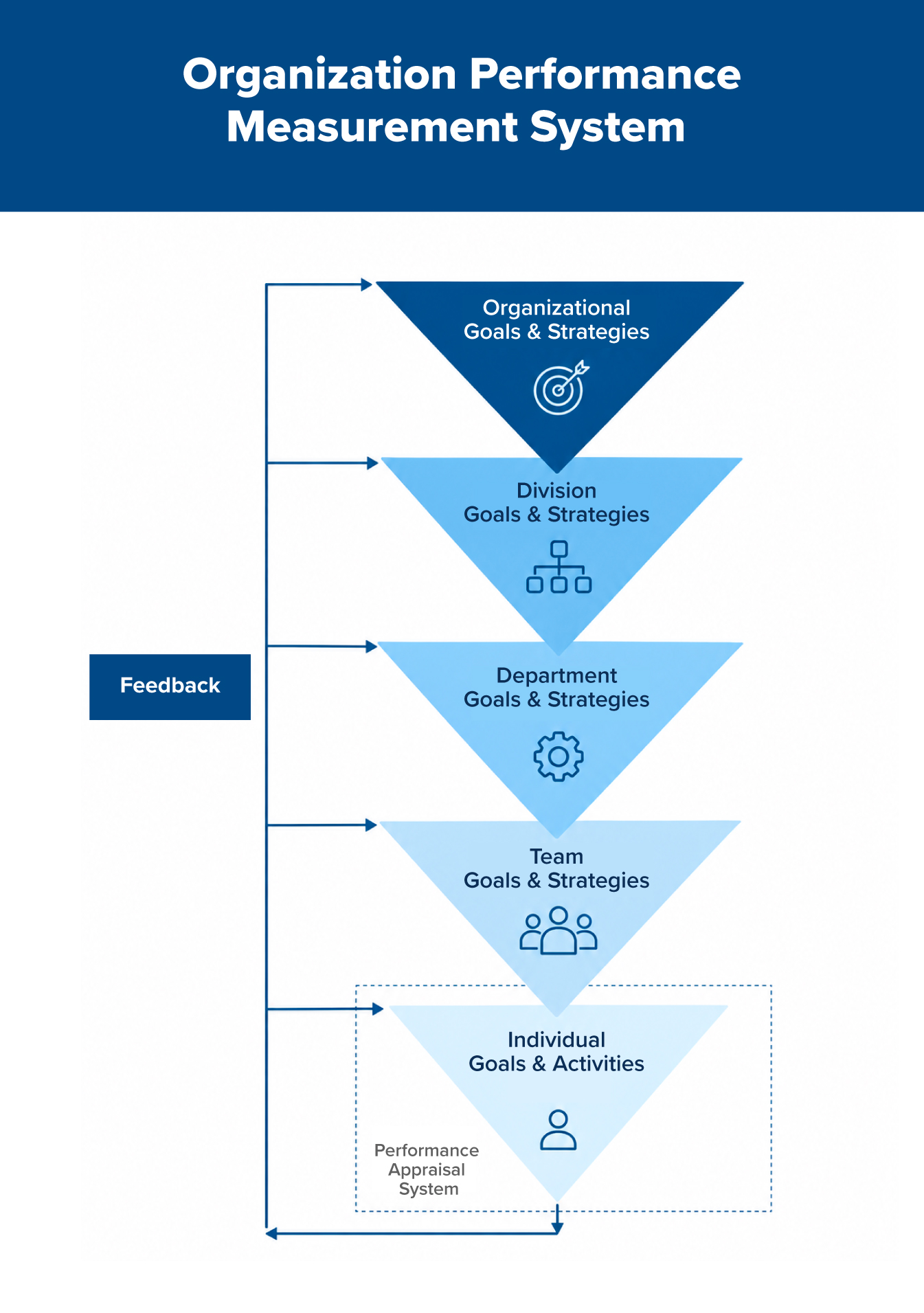
Merit pay, a specific form of pay-for-performance, relies on individual performance ratings (in the form of an appraisal). Expanding performance measures to larger organizational units increases the relevance (validity) of individual performance. The idea here is that the sum of individual performance should link (generalize) to the performance of broader organizational units and, ultimately, the entire enterprise. This can be done in the following steps:
- Determine organizational goals and strategies. Select metrics that validly relate to those goals and strategies.
-
Systematically link enterprise performance measures to the goals/indicators of constituent units (e.g., divisions, departments, teams, groups) and, ultimately, individuals (performance appraisal). The network of measures provides feedback to all organizational units and the enterprise as a whole. (See figure below)
- Use a comprehensive measurement system to help decide on indices (if needed) and link them. Examples of these can be found in prominent management and industrial/organizational psychology literature, such as:
- Evaluate the performance of the entire organization and/or constituent units.
Factor Generational Differences in Feedback
The U.S. workforce currently consists of five generations, which is unprecedented. Recent research shows younger generations (millennials and those in Generation Z) respond better to frequent and detailed feedback than their older counterparts (Baby Boomers and Generation X). Managers who take into account the generational differences in feedback stand a better chance of steering employees to anticipated behaviors that support business strategies. Here are a few practical ideas on how to do this:
- Train and develop managers on generational differences in performance feedback.
- Encourage managers to ask employees what they need to succeed. Then, find ways to help those employees achieve their goals.
- Explain to employees their roles in the bigger picture of the organization. Show employees what promotional opportunities exist.
Editor’s Note: Additional Content
For more information and resources related to this article, see the pages below, which offer quick access to all WorldatWork content on these topics:

#1 Total Rewards & Comp Newsletter
Subscribe to Workspan Weekly and always get the latest news on compensation and Total Rewards delivered directly to you. Never miss another update on the newest regulations, court decisions, state laws and trends in the field.