For WorldatWork Members
- Engage Member Community, information and connection resource
- 2026 Priorities of Total Rewards Leaders, research
- How to Reward Top Performers When Pay Raises Aren’t Possible, Workspan Daily Plus+ article
- Emphasize the Value of Total Rewards During Economic Uncertainty, Workspan Daily Plus+ article
- Total Rewards Competitiveness Analyzer: Understand How You Stack Up, Workspan Daily Plus+ article
- From Perks to Performance: Total Rewards as a Strategic Force, Workspan Magazine article
- Pivot on Pay: Getting Creative to Attract and Incentivize Talent, Workspan Magazine article
For Everyone
- Total Rewards ’26, conference
- The Keys to Creativity and Driving Innovative Total Rewards, Workspan Daily article
- Alignment, Market Competitiveness Are TR Leaders’ Top 2026 Priorities, Workspan Daily article
- The Importance (and Outcomes) of Flexible, Agile Rewards Strategies, Workspan Daily article
- How Startups May Better Anticipate and Address Critical Talent Needs, Workspan Daily article
- Business Acumen and Communication Strategies in Total Rewards, course
- Total Rewards Priorities Quiz, assessment tool


Do you run HR for a smallish company? Do you have a smallish budget? Do you have biggish ambitions?
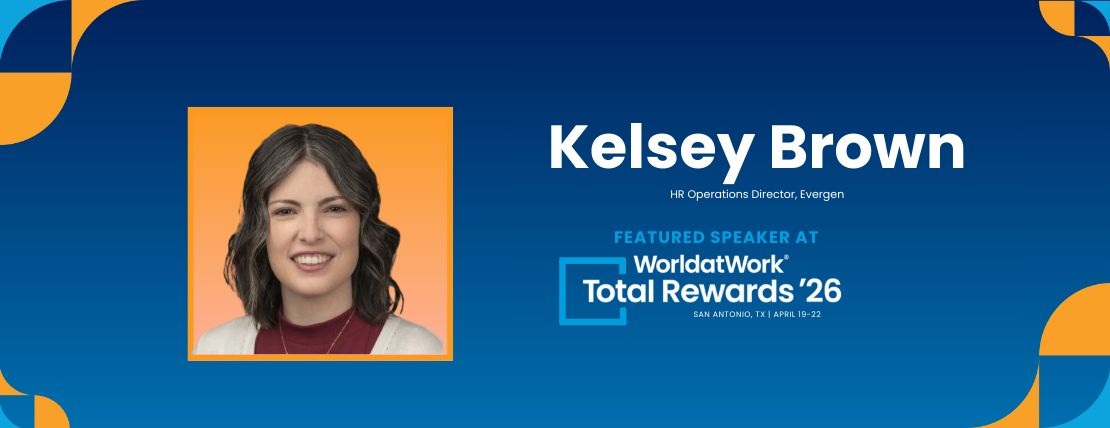
If you check all those boxes, you should get to know Kelsey Brown.
Brown, a WorldatWork member, has climbed the function’s ranks over the past decade-plus … from HR intern to operational support specialist to HR manager to total rewards manager. Today, she’s the HR operations director for Evergen, a 900-employee contract development and manufacturing organization in the life sciences industry.
This HR leader admits she has gotten fairly comfortable “making magic happen with limited resources.” And at WorldatWork’s Total Rewards ’26 conference, which takes place April 19-22 in San Antonio, Texas, she will share some of her secrets with attendees.
In her April 20 session, titled “Big Dreams, $0 Budget: Sparking Creativity at Small Companies,” Brown will help you get creative and optimize your efforts around benefits, employee value proposition and employee engagement.
Workspan Daily editor Paul Arnold recently connected with Brown and got some big insights from six little questions.
Check out Workspan Daily’s on-site coverage of Total Rewards ’26:
- There Is a Distinct Power in Knowing What Matters to Your Workers
- WorldatWork, HRCI Leaders Kick Off Program Exploring Work’s New Era
- Why Bravery Is a Formal Habit HR Pros Need to Build and Lean Into
- Cha-Ching: How to Transform HR into a Profit Center
Check out Workspan Daily pre-conference coverage on Total Rewards ’26:
- To Enhance Employee Experience, Lean into Integrity, ‘Radical Honesty’
- Conference Session Takes Community Approach to Solving HR Problems
- BIG Ideas: Learn How to Get the Most Out of a Small HR Budget and Team
- Hard Choices, Soft Solutions: A Considerate Approach to Compensation
- Making the Leap to a Pay-for-Performance Approach That Works
- Are You Speaking Gen Z’s Language When It Comes to Total Rewards?
Arnold: I love the title and the premise of this conference session. What inspired you to share your thoughts and story on being creative and value-driven when department budgets are constricted?
Brown: I attended last year’s WorldatWork conference and heard so many innovative and forward-thinking ideas shared by large organizations with significant HR resources. While the concepts were incredibly valuable, I kept thinking about professionals working in small to mid-size companies who don’t always have large teams, expansive budgets or dedicated centers of excellence to bring those ideas to life.
In my own experience, constraints often drive the greatest creativity. I wanted to create a space focused on practical translation, like how HR leaders can take “big ideas” and adapt them into scalable, value-driven solutions that work within real-world limitations. This session is about empowering teams to be strategic and innovative regardless of budget size and showing that meaningful impact comes from intentional design, not just financial investment.
Arnold: In your opinion and experiences, what are the pros and cons of trying to “make magic happen with limited resources”?
Brown: I’ve found that working with limited resources actually can be one of the greatest catalysts for innovation. The biggest advantage is clarity. Constraints force teams to prioritize what truly drives value for employees and the business. You become more intentional, more creative and more collaborative because you can’t rely on adding another tool or program to solve every problem. Some of the most impactful solutions I’ve seen have come from simplifying processes, leveraging existing partnerships or redesigning how we communicate and deliver value rather than increasing spend.
That said, there are real challenges. Limited resources can create fatigue if teams feel they are constantly being asked to do more with less, and there’s a risk of undervaluing HR work when success depends heavily on creativity and extra effort rather than investment. The key is balance: using constraints as a driver for innovation while still advocating for sustainable solutions and demonstrating measurable impact that earns future investment.
Ultimately, “making magic happen” works best when it’s paired with clear priorities, leadership alignment and a focus on outcomes rather than perfection.
Arnold: Sometimes the biggest ideas can come from the smallest of companies. What idea or ideas really stick out to you — either ones you came up with and implemented or one or more you’ve picked up from others and adopted? What made them unique and memorable?
Brown: One that has really stuck with me is the power of fully utilizing the resources already available within an organization before introducing something new. In smaller and mid-size companies especially, innovation often comes from reimagining what you already have rather than implementing another platform or program for employees to learn and navigate.
In my experience, some of the most successful initiatives have come from leveraging existing tools, whether that’s HR information system capabilities, communication channels, manager touchpoints or recognition programs, and connecting them more intentionally. Instead of adding complexity, we focused on simplifying the employee experience by using free or low-cost resources already in place and redesigning how they were used. The impact was significant because adoption was higher, leaders felt more confident and employees weren’t overwhelmed by yet another system.
Need a job description platform? Nope, we already have a document management system in the organization for our quality documents that works the same way. There’s no need to make things more complex. Need a social feed for employees? Nope, our Microsoft 365 accounts can do that using a premade Microsoft app with no additional cost. There are so many solutions if only we are curious enough to think outside the HR box.
Arnold: Are there pieces of the HR puzzle that you have found to be more easily addressable when funds are low but creativity is high?
Brown: Communication, manager capability and employee experience design are areas where thoughtful execution often matters more than budget. Clear communication around total rewards, career growth or organizational priorities can dramatically improve engagement without requiring new programs, just better storytelling and consistency.
Manager enablement is another area where creativity has a high return. Providing leaders with simple tools, conversation guides or peer learning opportunities can strengthen performance management and employee development without significant financial investment.
I’ve also found recognition and culture-building to be highly adaptable in low-budget environments. When recognition is timely, authentic and connected to company values, it resonates more than expensive incentives. Many impactful solutions come from leveraging existing systems, empowering leaders and listening closely to employee feedback rather than launching something entirely new.
Arnold: This session will be a roundtable format where you are also inviting audience members to share some of their inventive strategies. How does collaboration, networking and benchmarking elevate your personal creativity and inventiveness?
Brown: Collaboration and benchmarking are some of the biggest drivers of my creativity because my No. 1 CliftonStrengths theme is “Maximizer.” I naturally see potential in ideas, especially in hearing how others approach challenges. When I listen to peers share what’s working in their organizations, it immediately sparks vision around how those concepts could be refined, scaled or adapted in a different environment.
That’s one of the reasons I chose a roundtable format for this session. Some of the most innovative solutions in HR don’t come from polished case studies; they come from honest conversations about experimentation, constraints and lessons learned. Networking allows us to benchmark in real time, translating ideas across industries, company sizes and resource levels.
For me, collaboration turns inspiration into application. Hearing diverse perspectives helps me move from “That’s a great idea” to “How could we make this even more impactful and practical for our workforce?” The collective creativity in a room often produces better solutions than any one organization could develop alone, and that shared learning is what makes our profession continually evolve.
Arnold: What is one piece of advice you could offer HR/TR pros regarding budget maximization?
Brown: Start by maximizing clarity before maximizing spend. Many organizations already invest significantly in pay, benefits, development and well-being, but employees don’t always understand the full value available to them. Before adding new programs, focus on improving how existing resources are communicated, connected and experienced.
Ultimately, budget maximization isn’t about spending less, it’s about ensuring every dollar clearly supports employee impact and business outcomes. When HR can demonstrate that alignment, creativity turns into credibility and credibility earns future investment.
Check out Workspan Daily’s coverage of the Total Rewards ’25 conference:
- Might a Sales Mindset Be Your Key to Total Rewards Success?
- The Monumental Mission of Meaningful Mentorships
- Proactive TR Pros See ‘Train’ of Change Coming, Take Steps to Act
- The Keys to Creativity and Driving Innovative Total Rewards
- The Pros and Cons of Giving Managers Discretion on Merit Increases
- Using Analytics, Innovative Framework to Transform HR/Total Rewards
- How An Industry Leader Sees Technology Transforming Total Rewards
- Biopharma Compensation Leader Has Put AI Under the Microscope
Editor’s Note: Additional Content
For more information and resources related to this article, see the pages below, which offer quick access to all WorldatWork content on these topics:

#1 Total Rewards & Comp Newsletter
Subscribe to Workspan Weekly and always get the latest news on compensation and Total Rewards delivered directly to you. Never miss another update on the newest regulations, court decisions, state laws and trends in the field.