For WorldatWork Members
- Five Emerging Workplace Trends Affecting the Employee Experience, Journal of Total Rewards article
- Leveraging the HR/TR Value of Ombuds Data, Workspan Magazine article
- How Workplace Culture Can Improve Engagement and Retention, Workspan Daily Plus+ article
- The Nuts and Bolts of Retooling the Onboarding Experience, Workspan Daily Plus+ article
- Stay Interviews: A Simple Way to Boost Retention, Workspan Daily Plus+ article
- Crafting the Employee Value Proposition, tool
For Everyone
- Total Rewards ’26, conference
- Could Culture Be the Most Important Benefit You Provide Your Workers? Workspan Daily article
- Is Your Organization Living Up to Its Employee Value Proposition? Workspan Daily article
- Accessibility and Belonging: The Keys to Employee Retention, Workspan Daily article
- Pay with Purpose: Driving Employee Engagement Through Compensation, on-demand webinar


“A well-designed employee experience ... touches every function of HR. It influences performance management, compensation and benefits, safety, scheduling, development, succession planning, and leadership effectiveness, to name a few.”
— Charles Ramos, founder and principal consultant, Zenergy HR Consulting
It’s been said “employee experience” is no longer an “HR project,” with traditional, predictable elements. It’s now considered a highly complex, thoughtful, enterprise-wide strategy, and encapsulates all the day-to-day issues employees face at work.
If the employee experience bar has been raised, have you and your HR organization evolved your definition, vantage points and game plans accordingly? If you have — or if you have not — the ramifications to metrics you’re at least partially responsible for (hiring, retention, workforce satisfaction and morale, productivity, etc.) are probably significant.
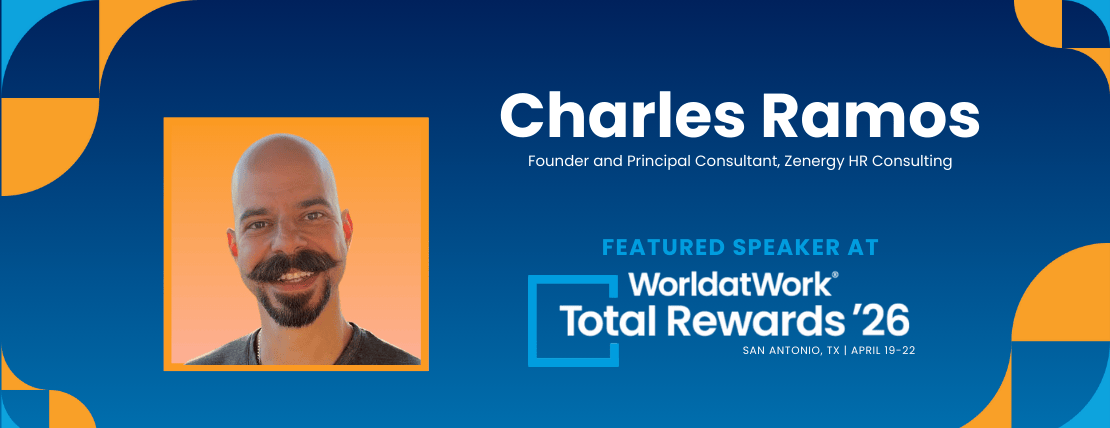
Charles Ramos has some strong thoughts on the changing nature of employee experience. As a “people strategy and culture” consultant who has held multiple roles as an HR practitioner and manager in his career, he has seen first-hand what happens when employees “feel valued, supported and genuinely understood” on a daily basis.
Ramos will share his stories and approaches in a spotlight session at WorldatWork’s Total Rewards ’26 conference, coming up on April 19-22 in San Antonio, Texas.
His April 21 presentation, titled “From Hiring to Staying: Designing Employee Experience as a Talent and Retention Ecosystem,” will outline how to use an effective employee experience to:
- Recruit in a tough market (when you can’t outpay the competition);
- Hire for mission, impact and role-fit instead of checking résumé boxes;
- Better understand how an employee’s first 90 days determine long-term retention;
- Shape managers to become a true “total rewards delivery system”; and,
- Build a simple, repeatable approach to workforce planning, focused on future skills, internal pipelines and enhancing capability.
Workspan Daily editor Paul Arnold recently connected with this industry leader to discuss five questions on this important HR topic.
Check out Workspan Daily’s on-site coverage of Total Rewards ’26:
- There Is a Distinct Power in Knowing What Matters to Your Workers
- WorldatWork, HRCI Leaders Kick Off Program Exploring Work’s New Era
- Why Bravery Is a Formal Habit HR Pros Need to Build and Lean Into
- Cha-Ching: How to Transform HR into a Profit Center
Check out Workspan Daily pre-conference coverage on Total Rewards ’26:
- Conference Session Takes Community Approach to Solving HR Problems
- BIG Ideas: Learn How to Get the Most Out of a Small HR Budget and Team
- Recognize that Employee Recognition Needs Some Attention
- Hard Choices, Soft Solutions: A Considerate Approach to Compensation
- Making the Leap to a Pay-for-Performance Approach That Works
- Are You Speaking Gen Z’s Language When It Comes to Total Rewards?
Arnold: From your perspective, how has employee experience changed? What does it encompass, and what does (or should) it mean for today’s organizations, workforces, and HR and total rewards professionals?
Ramos: Employee experience has evolved in two meaningful ways. First, organizations now clearly understand the return on investing in people. When employees are worried about pay, fairness or basic security, performance suffers. When those needs are met, people can focus, contribute and perform at their highest level. Second, there’s been a shift toward a more holistic understanding of employees as human beings — not just outputs. Performance is no longer viewed in isolation but in the context of real life, with stressors and responsibilities that exist beyond the workplace.
To me, employee experience encompasses everything an employee perceives about an organization — from the moment they encounter the employer brand, to how they’re treated day-to-day, to how they eventually exit. It’s the full story, not just the highlights or the issues. For organizations today, this means radical honesty. If you want to attract aligned, high-quality talent, you must be clear about who you are and how you operate. It’s an employee’s market, and there are no shortcuts. Integrity is still the most effective strategy.
For HR and total rewards professionals, this evolution is energizing. It creates space for HR to move beyond compliance and cleanup work and into true strategic partnership. When organizations get the fundamentals right, these roles become not only more impactful but more sustainable — and outdated, fear-based, short-term practices naturally fall away.
Arnold: In your opinion, why has employee experience grown in importance — to the point of it being considered a true talent strategy differentiator? And, what factors have led to its heightened status?
Ramos: I think it has grown for a very simple reason: Humans are still the primary resource. Organizations don’t exist without people — at least not yet. Maybe one day we’ll see fully autonomous companies run by artificial intelligence, but until then, humans are the engine. And, humans are dynamic. They’re coachable, trainable, adaptable. They can be developed, inspired, supported — or burned out, disengaged and pushed away. They respond to respect, integrity and purpose far better than pressure or manipulation. We all know the saying, “You catch more bees with honey than vinegar.” The same applies at work. When people are treated well and given what they need to succeed, organizations spend far less time dealing with unnecessary friction, dysfunction and suffering.
What’s elevated employee experience to a true talent strategy differentiator is leaders now see the payoff. Tools like personality and behavioral assessments have helped improve fit — within roles, teams and cultures — but the bigger shift is philosophical. Leaders are realizing that when they operate with consistency, fairness and integrity, employees respond. [Those employees] follow, commit and perform.
This isn’t complicated. It’s not about clever tactics or manipulation. It’s about doing the right thing consistently and resisting the temptation to cut corners. Organizations that understand this now see employee experience not as a “nice to have” but as a competitive advantage. So, why wouldn’t you treat it as a talent strategy?
Arnold: What are the keys to designing an effective employee experience? And, how have your experiences as a practitioner and consultant shaped that design strategy?
Ramos: The strategy is simple but it requires discipline: observe, listen, assess, improve, repeat.
You can’t design a meaningful experience without first understanding it — and that starts with talking to employees and truly hearing them. But honest feedback only happens when psychological safety exists. Without trust, you’ll just get polite answers or what people think leadership wants to hear. When safety is established, the truth shows up — and that’s where real design begins.
Empathy and emotional intelligence are critical here. Leaders and HR professionals must be willing to see the organization through the employee’s eyes, not just through dashboards or survey scores. That’s what allows the experience to be tailored and impactful instead of generic or “off-the-shelf.”
It’s also important to pay attention to the small things. An employee’s experience is shaped just as much by subtle, everyday friction — like a broken restroom faucet or a confusing process — as it is by big programs and policies. Those details rarely surface in surveys, but they absolutely affect engagement. Similar to a lean or continuous improvement approach, organizations can map what a day, month and entire career look like for an employee — and then refine it intentionally.
As a practitioner, this work has been incredibly rewarding. I’ve had employees tell me they felt valued, heard and supported because their experience was designed with care — from onboarding onward. They knew where to go, who to ask, and felt confident stepping into their role from day one.
As a consultant, the work has been more challenging at first — often requiring leaders to rethink how much influence experience design actually has. But once those experiences are mapped, implemented and refined, leadership and HR consistently see the payoff. Time is saved. Friction is reduced. And, the organization runs better — not because it’s more complex, but because it’s more intentional.
Arnold: How might a well-crafted employee experience apply to — and impact — recruiting and retention? Conversely, how might an improper or ineffective approach to employee experience impact these areas?
Ramos: A well-crafted employee experience shows up immediately in recruiting because candidates can feel it. Humans are remarkably good at detecting authenticity — or when something feels off. When employee experience is genuinely aligned with an organization’s mission, vision, principles and core values, it naturally shows up in job postings, communication cadence, interviews and follow-through.
For example, if an organization claims “people first” as a core value, candidates will expect timely, respectful communication during the hiring process. When that happens, the message lands: They mean what they say. When it doesn’t, trust erodes before day one.
Recruiting, however, is only the opening chapter. Retention is the long-form story. Much like moving from soundbites to long-form conversations, time reveals the truth. A strong employee experience becomes increasingly visible as employees stay, grow and watch how new hires are onboarded and supported. Consistency builds confidence; inconsistency drives exits.
A well-designed employee experience also touches every function of HR. It influences performance management, compensation and benefits, safety, scheduling, development, succession planning, and leadership effectiveness, to name a few. When employees are fairly paid, supported by strong managers, given opportunities to grow and shown a clear future within the organization, retention becomes a natural outcome — not a forced one.
Conversely, when employee experience is poorly designed or misaligned with what the organization claims to stand for, the impact is immediate and costly. Recruiting becomes harder, turnover accelerates, trust declines and HR spends more time reacting to problems than enabling performance.
In short, employee experience isn’t a separate initiative — it’s the connective tissue. How an organization shows up for its people determines who it attracts, who it keeps and who decides it’s time to leave.
Arnold: If you could share one sage piece of advice or lesson learned on designing a high-impact employee experience, what would it be?
Ramos: Ask powerful questions — and then listen carefully, not just to what employees say, but to what they don’t say.
Over time, I’ve learned trust isn’t built through surveys or programs alone; it’s built through genuine curiosity and thoughtful, well-intended questions. When employees sense you’re truly interested — not evaluating, fixing or judging — they open up. They’ll tell you how they actually feel, where processes break down, and often offer insights that leadership would never see otherwise.
The key is how you listen. Remove judgment. Remove assumptions. Set aside what you think you already know. Let people explain their experience in their own words. And when something feels incomplete, ask a follow-up — kindly, respectfully and with care.
That combination of curiosity, presence and kindness goes a long way. It not only surfaces better information. It creates the trust necessary to design an employee experience that truly works.
Check out Workspan Daily’s coverage of the Total Rewards ’25 conference:
- Might a Sales Mindset Be Your Key to Total Rewards Success?
- The Monumental Mission of Meaningful Mentorships
- Proactive TR Pros See ‘Train’ of Change Coming, Take Steps to Act
- The Keys to Creativity and Driving Innovative Total Rewards
- The Pros and Cons of Giving Managers Discretion on Merit Increases
- Using Analytics, Innovative Framework to Transform HR/Total Rewards
- How An Industry Leader Sees Technology Transforming Total Rewards
- Biopharma Compensation Leader Has Put AI Under the Microscope
Editor’s Note: Additional Content
For more information and resources related to this article, see the pages below, which offer quick access to all WorldatWork content on these topics:

#1 Total Rewards & Comp Newsletter
Subscribe to Workspan Weekly and always get the latest news on compensation and Total Rewards delivered directly to you. Never miss another update on the newest regulations, court decisions, state laws and trends in the field.