For WorldatWork Members
- Takeover or Transformation? How AI Is Reshaping Jobs, the Workforce, Workspan Magazine article
- How Human Workers and AI Can Become Valuable Colleagues, Workspan Daily Plus+ article
- Decoding AI Beliefs and Behaviors in Four Classes of Workers, Workspan Daily Plus+ article
- Ready Player 1: Using Gamification to Strengthen AI Adoption, Workspan Daily Plus+ article
- How to Build Employee Trust in the Age of AI, Workspan Daily Plus+ article
For Everyone
- Easy AI Tips to Improve Benefits Communications, Workspan Daily article
- From Sci-Fi to Reality: How AI Could Transform Sales Comp, Workspan Daily article
- Buying Beyond the Buzzwords: Critical Questions for Using AI in Comp, Workspan Daily article
- Psychology’s Role in Moving Workers Forward with AI Adoption, Workspan Daily article
- Why Workers Fear AI: It Starts with Leadership, Workspan Daily article


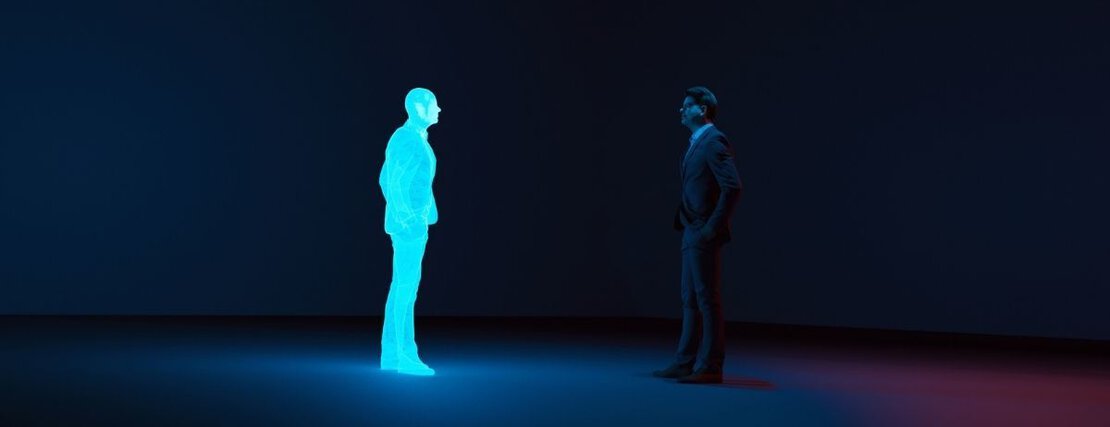
A company leader’s workday generally includes issuing instructions to employees, offering encouragement and support, and answering questions about the business. But what if it wasn’t truly that leader speaking to the workforce? What if, instead, it was an artificial intelligence (AI) avatar built and trained on their image, their voice, and even their mannerisms, perspectives and knowledge.
That may soon be a digital reality for organizations. Meta, the parent company of Facebook, recently announced it was developing a workforce-focused “AI clone” of their CEO, Mark Zuckerberg. Other workplaces may soon follow. If you’re one of them, here’s what you should consider before you start creating digital twins of corporate leadership, senior managers and/or HR employees.
Access bonus Workspan Daily Plus+ articles on this subject:
- Are Corporate Advice-Giving Avatars Good or Bad for HR?
- Understanding the Legal and Regulatory Snares of Workplace ‘Twins’
- Q&A: Using an AI Clone to Streamline and Scale HR Messaging
Business Usages
According to futurist and AI expert Steve Sammartino, AI clones or avatars are already being used in a variety of ways in the workplace, including during first-round job interviews, onboarding, benefits information, IT support, learning and development training, and leadership messaging.
“The obvious reason [for ‘why’] is scale,” he said. “A CEO [or other ‘face of the company’] can only be in one room at a time, but a digital clone can be everywhere at once. It’s the corporate version of turning leadership into software.”
What’s more, he added, organizations can explore the use of AI clones to avoid “corporate memory loss” — the knowledge that slips away from meetings, emails, passing conversations and never-to-be-opened-again PowerPoint presentations.
“There’s also a cost story,” Sammartino said. “If a company can replace 500 repetitive internal conversations with one digital leadership avatar, it will. This is not just about communication. It is about labor arbitrage wearing a friendly human face.”
A Hands-On Experiment
In his work as senior director of global total rewards at smart home product company Resideo and as cofounder of benefits communications platform FlashBenefits, Josh Lemon uses AI avatars that are not based on real people. But he did mention experimenting with an AI clone of himself while discussing this topic with Workspan Daily.
When creating his clone, Lemon learned the technology has progressed significantly, noting how anyone with a webcam and a decent computer microphone can create a digital twin by recording themselves speaking for as little as 15 seconds.
When asked why organizations may opt to use an AI “twin” rather than a generic image, Lemon said it could be to add some credibility to the messaging.
“If you see something that looks like your CEO [speaking to you], you might feel like you’re getting a message [from your actual] CEO,” he said.
Key Takeaways for Employers
The first step for employers is to disclose prior to any messaging using an AI clone that the person speaking is a digital avatar sharing a message from the human employee, said Lemon.
“That lets people understand this is clearly meant to be a representative,” he said. “It goes from being a deepfake to letting people know it was the intended format for them to receive the information.”
Sammartino also urged businesses to use avatars to transmit repeatable information, but not responses that carry human consequences.
“A digital HR avatar can explain a policy, but it cannot care. A CEO clone can deliver a message, but it cannot lead,” he said. “So, the test should be simple: Use avatars where they remove friction, not where they remove humanity.”
Editor’s Note: Additional Content
For more information and resources related to this article, see the pages below, which offer quick access to all WorldatWork content on these topics:

#1 Total Rewards & Comp Newsletter
Subscribe to Workspan Weekly and always get the latest news on compensation and Total Rewards delivered directly to you. Never miss another update on the newest regulations, court decisions, state laws and trends in the field.