
For WorldatWork Members
- HR + Total Rewards: The Partnership That Powers Business Success, Workspan Magazine article
- 2026 Priorities of Total Rewards Leaders, research
- Total Rewards Inventory of Programs and Practices, research
- Building Bridges: Total Rewards Strategies for Effective Collaboration, Workspan Daily Plus+ article
- Guided Checklist for Analytic Thinking and Data-Driven Action in Total Rewards, tool
For Everyone
- Total Rewards ’26, conference
- Conference Session Takes Community Approach to Solving HR Problems, Workspan Daily article
- WorldatWork Research Shows Key Shifts in Pay, Benefits and Culture, Workspan Daily article
- Why Total Rewards Needs to Create a Strategic Alliance with IT, Workspan Daily article
- Total Rewards Priorities Quiz, assessment tool
- Essentials of Total Rewards, course
- The WorldatWork Handbook of Total Rewards, book


Over the past eight years, total rewards has transformed from somewhat of an organizational burden to a powerful driver of talent attraction and retention that directly fuels results. Deloitte’s 2018 research on rewards found the function struggling to keep up in a rapidly changing world of work. Today, things are different: An updated High-Impact Total Rewards (HITR) study, completed in late 2024, showed how rewards has evolved toward:
- Leveraging technology to sense the wants and needs of the workforce;
- Operating with transparency; and,
- Recognizing the achievements of individuals across the workforce in the way that suits them best.
It is clear, based on the research, that organizations in 2026 and beyond should invest in their total rewards (TR) functions to make related offerings a competitive differentiator. But as peers across industries elevate their rewards approach, the question becomes: How will we stand out? The answer isn’t simply adding more perks — it’s making intentional investment choices in the parts of the TR experience that deliver the most value for the workforce and the business. Through honest self-assessments, targeted growth plans and an intentional focus on the key drivers of maturity, organizations can advance their own maturity in this area and strengthen their position as an employer of choice.
Access additional Workspan Daily articles from this research series:
- How Much Have Rewards Practices Changed Since 2018?
- The Importance (and Outcomes) of Flexible, Agile Rewards Strategies
- Recognition’s Rise in the New World of Total Rewards
- AI Just Might Reshape Your Rewards Strategies (for the Better)
Know Thyself, Know Rewards
To rise in the ranks of TR maturity, organizations must first gain a thorough understanding of the current state and spend of their programs. The good news is that it’s never been easier to review a given function: Advanced technology has ushered in a golden age of analytics, and organizations can answer the call by tapping tech and a variety of data sources to create a holistic picture of existing conditions. By gaining a real-time understanding of worker sentiment — in addition to current trends in the market — organizations can enable an agile approach that treats TR like an investment portfolio:
- Doubling down where returns are highest;
- Reassigning low-value spend away from under-valued benefits; and,
- Funding targeted experiments to help advance the worker experience.
TR professionals also have access to more diagnostic tools than ever to help gain a thorough and actionable understanding of their current-state rewards maturity. Deloitte’s updated Total Rewards Maturity Model can help organizations perform an honest assessment of their rewards offerings and determine the actions (and investments) that will move the organization further along the maturity curve.
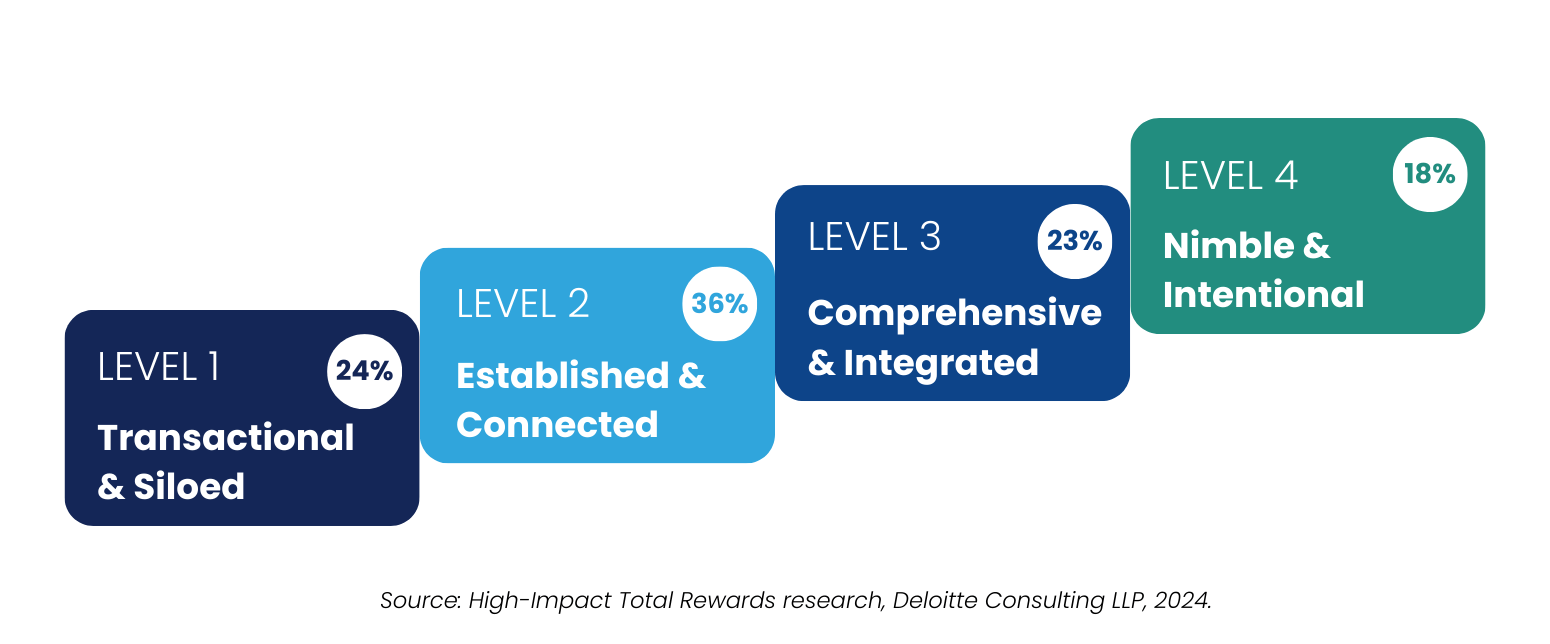
In addition to tools and tech, organizations should harness workforce sensing methods like direct employee surveys and conjoint analysis — a survey-based statistical method adapted to help explain consumer preferences — to continuously evaluate preferences around current and potential future rewards offerings. Organizations also should prioritize constantly sensing external market conditions to adjust compensation and benefits offerings to remain competitive within current market realities.
Once leaders have a foundational understanding of their TR maturity, they can shift focus to zeroing in on critical gaps in their strategy and determining the offerings to add, remove, evolve or pilot to deliver a competitive program.
Setting Sights on a More Mature Rewards Function
Assessing rewards maturity is only the start of the journey toward competitive differentiation. After gaining a thorough understanding of their current programs, TR professionals should set targeted goals and an investment strategy — what to invest in, what initiatives to end, what outcomes to expect and how to measure value — to boost program maturity. Consider starting with the year ahead: What offerings and strategic pivots can you and your team focus on to create a more effective TR function?
“Set-it-and-forget-it” rewards strategies are a relic of the past. To establish the TR function as a competitive differentiator, organizations should remain agile and responsive to both the workforce and external market conditions.
Understanding the Key Drivers of TR Maturity
Deloitte’s 2024 HITR research, based on surveys and interviews with more than 700 rewards organizations and professionals, identified the top drivers of TR maturity and surfaces high-leverage investment areas to improve maturity and capture value. These include:
- Strategy. Develop and execute a TR strategy that aligns to and reinforces business goals even through changing market conditions and evolving workforce expectations.
- Communication. Effectively convey the scope and value of rewards offerings available to the workforce. This includes establishing transparency around rewards decisions and philosophies, delivering effective rewards education and supporting accountability for equitable rewards decisions.
- Recognition. Build a culture of always-on recognition for both individuals and teams — including non-monetary rewards, on-the-spot awards and a recognition philosophy integrated into the overall TR strategy. This helps enable leaders to invest in moments that shape experience and retention.
Every mature approach to TR starts with strategy. “Set-it-and-forget-it” rewards strategies are a relic of the past. To establish the TR function as a competitive differentiator, organizations should remain agile and responsive to both the workforce and external market conditions. Organizations seeking to increase their TR maturity should frequently assess and adjust their compensation according to workforce and market sensing. It’s also critical that organizations leverage data from a variety of sources (e.g., worker feedback, their HR information systems, market survey information) to inform their strategy and regularly adjust their approach according to their findings.
But strategy alone can’t move the needle on an organization’s brand as an employer. It’s crucial that organizations establish frequent and transparent rewards communications to ensure workers understand the offerings available to them — and their value — as well as the philosophies driving those offerings’ inclusion within the broader rewards package. Providing clarity behind a variety of offerings also can encourage workers to take advantage of programs and engage with the offerings that best suit their individual needs.
A robust approach to recognition can help ensure workers feel appreciated for the work they deliver — and, in turn, establish an organizational brand centered around workforce appreciation. But recognizing employees doesn’t have to cost an arm and a leg. The HITR research found that 54% of workers prefer a verbal thank you for their day-to-day accomplishments, compared to just 7% for celebrations and gifts. Workforce sensing is critical here, too; no two workers are alike, and by consistently personalizing recognition strategies according to the preferences of individual workers, organizations can establish a culture of recognition as a foundational pillar to a mature rewards strategy.
A Stepped Approach to Maturity Growth
Organizations seeking to establish a more mature TR function should make 2026 their year. Targeting a 12-month timeframe to implement an intentional, considered approach to improving the rewards function — in concert with tools like a TR maturity model — can help organizations take specific and material action to boost their maturity and establish their rewards offerings as a competitive differentiator. The following considerations can help TR leaders get started.
- Assess the current state. The first step of improving the function is an honest appraisal of its current state. Leverage a wide variety of internal and external data sources (e.g., workforce surveys, active and passive data/analytics, real-time market data) to generate a thorough understanding of the strengths and gaps of the function to date and identify high-impact investment (or reinvestment) opportunities.
- Build strategy across the organization. Effective strategies aren’t built in a vacuum. Build cross-functional relationships within HR and functions like finance and IT to determine feasible actions to take over the next three, six and 12 months to establish an agile and responsive rewards strategy.
- Prioritize transparent communication. A robust rewards program won’t move the needle on an organization’s brand as an employer if it is done from the shadows. Consider how to create greater clarity on the decisions and processes that guide compensation and benefits decisions so the workforce understands the nature and value of their TR offerings. When done correctly, this can increase realized value by driving understanding and employee uptake.
In a rapidly evolving world of work and rewards, organizations can’t afford to allow their TR functions to fall behind. Organizations that are mature in this area are harnessing vast swaths of data to get smart about decision-making, clearly communicating the value of their offerings and philosophies, and designing robust and efficient strategies engineered to drive value.
There’s never been a better time to prioritize increasing the maturity of the TR function. And by keeping a finger on the pulse of internal sentiment and external market conditions, they can move with confidence to create the mature and effective programs they need to see results.
Editor’s Note: Additional Content
For more information and resources related to this article, see the pages below, which offer quick access to all WorldatWork content on these topics:

#1 Total Rewards & Comp Newsletter
Subscribe to Workspan Weekly and always get the latest news on compensation and Total Rewards delivered directly to you. Never miss another update on the newest regulations, court decisions, state laws and trends in the field.