
For WorldatWork Members
- 5 Minutes With … Winnie Roberts, McKesson’s VP of Sales Comp, Workspan Magazine article
- Make No Mistakes: Avoiding Sales Incentives Slip-ups, Workspan Magazine article
- Sales Performance Management, research
- Sales Compensation Programs and Practices, research
- Sales Quota Setting Guide, tool
For Everyone
- 2026-2027 Salary Budget Survey, research
- The Hidden Forces Driving Annual Sales Compensation Changes, Workspan Daily article
- What Jobs Should (and Shouldn’t) Be on a Sales Compensation Plan? Workspan Daily article
- Sales Comp Trends: Navigating Plan Change and Execution Priorities, Workspan Daily article
- In Uncertain Times, Pursue Agility, Resiliency in Your Sales Comp Plan, Workspan Daily article
- How Job Archetype Drives Strategic Growth within a Sales Comp Program, Workspan Daily article


Around this time of year, organizations revisit their pay structures to ensure they remain competitive enough to attract and retain the sales talent required to execute the business strategy. At first glance, setting or updating a pay structure can seem straightforward: Gather market data and adjust pay levels. In practice, the process is more complex — especially for sales organizations, where jobs, talent profiles and pay structures often differ significantly from non-sales jobs.
Pay structures bring together reward philosophy, job architecture and market benchmarks to establish market-aligned pay ranges. Done well, they create a shared understanding of how job value is measured across the organization. These pay structures support better pay decisions, greater pay transparency, clearer career paths, and a stronger ability to attract, motivate and retain sales talent.
Foundational Elements for Setting Pay Structures
Effective pay structure design relies on several foundational elements that help organizations translate pay philosophy, market data and job-level distinctions into pay ranges that are consistent, transparent, scalable and aligned to business strategy.
Here are eight of those elements:
1. Pay Philosophy
Organizations should define a pay philosophy that reflects the caliber of sales talent required to execute the company’s go‑to‑market strategy and compete effectively for that talent. For example, an organization may set its pay philosophy at the 50th percentile of market pay. The executive team and compensation committee typically set the pay philosophy for the organization, and that same philosophy is generally applied to the sales organization.
2. Survey Selection and Target Peer Group
Most organizations use one to three pay surveys to benchmark and set pay levels. Common pay survey vendors include Aon Radford McLagan, Mercer/Marsh and WTW. Organizations should also define a target peer group to confirm that the data reflects the talent markets in which the organization competes for sales talent. The peer group should include companies where the organization competes for both product and sales talent.
To ensure sufficient data for relevant survey jobs and job levels by country, organizations should define 20 to 30 peer companies with each survey vendor. In countries with limited data counts, organizations may need to use a broader target peer group or a provided predefined industry cut. If there are not enough true peer companies in the survey source, organizations can expand the peer group to include organizations with similar sales motions. For instance, a specialty materials manufacturer may include companies that sell chemicals or other adjacent products through similar channels.
A common mistake, even among mature organizations, is to apply the same peer group used for the broader organization to the sales organization. Industry and sales motion can have a significant impact on sales pay levels, which means the peer group used for engineering, operations, finance or HR may not reflect the talent market for sales jobs. Sales organizations should use a sales-specific peer group that reflects where the organization competes for sales talent.
3. Pay-Setting Methodology
Organizations should define the methodology for setting pay structures, because it determines which market data elements are needed from survey sources and how the pay structure will be designed. Common approaches include:
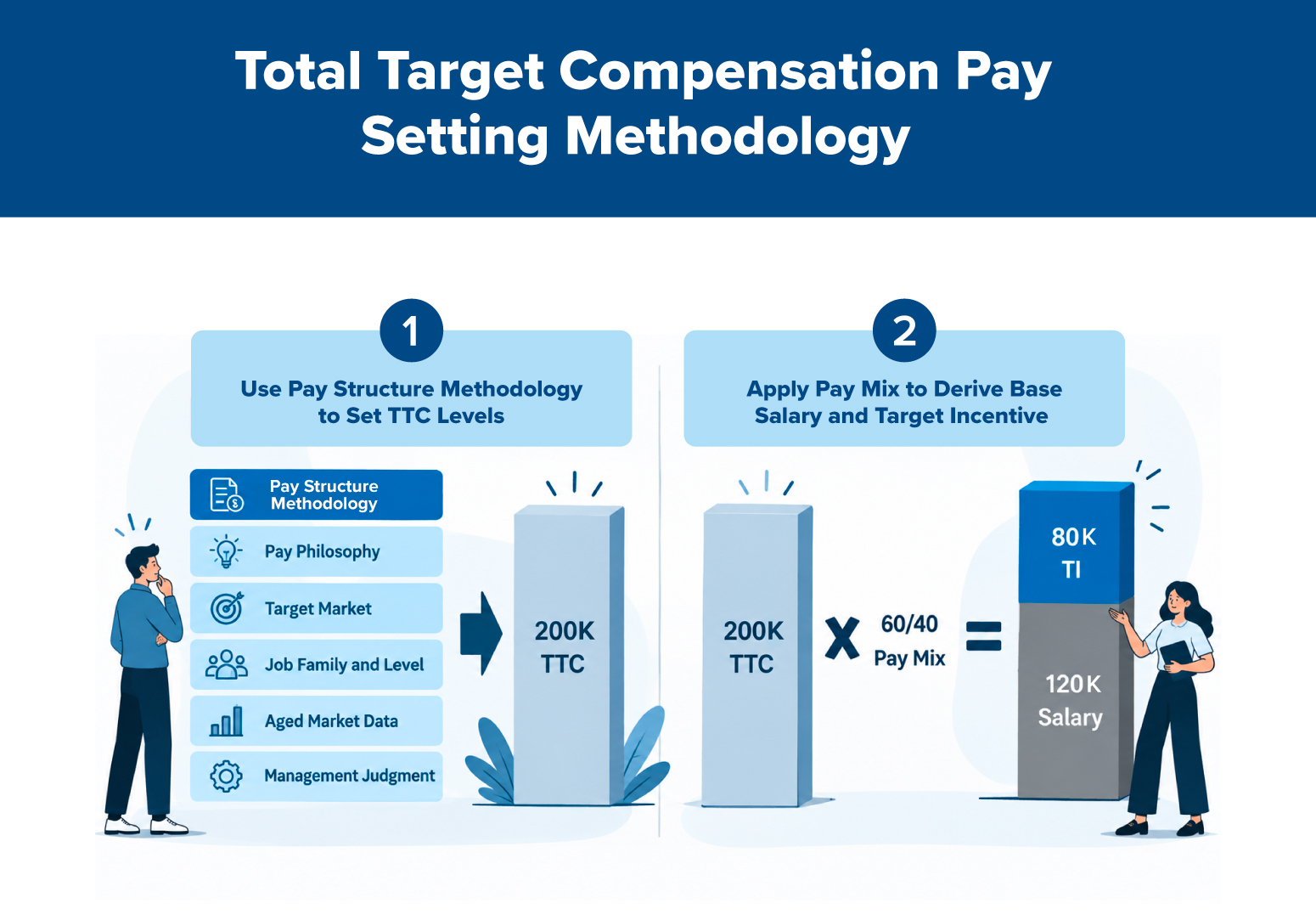
- Total target compensation (TTC). This method sets TTC, also known as on-target earnings (OTE), and then applies a pay mix to determine the base salary and target incentive. For example, a $200,000 TTC with a 50/50 pay mix translates to a $100,000 base salary and a $100,000 target incentive. This approach ensures total cash compensation is market competitive and is commonly used for sales jobs because it communicates the target incentive as pay at risk. The figure below provides a visual example for reference.
- Base salary plus percent of base. This method sets base salary first and then applies a percentage of base salary to determine the target incentive. For example, a $100,000 base salary with 100% of base pay mix translates to a $100,000 target incentive and $200,000 TTC. This approach is commonly used in corporate bonus plans and may be used for some sales compensation programs. But if the percentage of base isn’t aligned to market data, it can lead to misaligned TTC levels. Additionally, this approach does not communicate the target incentive as pay at risk.
- Base salary only. This method sets only the base salary and is commonly used for jobs on base salary plus commission plans. However, target pay or average actual pay data is still critical for setting target commission rates. For example, a company may divide the expected average commission by expected average performance to determine the target commission rate.
4. Market Data Elements
Organizations should gather the market data elements that align with their pay-setting methodology. Typically, this includes current fiscal year TTC or base salary (depending on pay setting methodology outlined in the previous point) at the incumbent level, aligned to the organization’s pay philosophy.
Organizations should also age market data forward to account for the time gap between when survey data is collected and when pay structures are released. This is usually done using country-specific pay increase assumptions from market data sources such as WorldatWork or Economic Research Institute (ERI). For example, a company may apply a 3.5% aging factor to the United States market data.
5. Pay Ranges
Organizations should determine pay range width by defining the minimum and maximum values around the midpoint. Range width should reflect the degree of variation in job scope/experience, expected time within a level and desired overlap between adjacent levels. While standard sales pay ranges are 10% to 20% around the midpoint, there are exceptions. Broader ranges, such as 40%, may be appropriate for broadly defined job levels. Ranges that are narrower, such as 10%, may be appropriate for more narrowly defined levels.
Pay ranges may not be necessary for jobs that use a fixed pay structure. Under this type of framework, all incumbents in the same job and level have the same pay opportunity. Fixed pay levels may be appropriate for standardized jobs that require a similar set of skills and experience, or for jobs with many levels and a fast promotion path. One example is an inside lead generation job, which may use a fixed pay structure when it requires entry-level skills, and incumbents are typically promoted within six to 18 months.
6. Geographic Pay Differentials
Many organizations create two or more pay structures within a country to account for differences in labor costs across geographies. For instance, a company may use a premium structure for high-cost markets (e.g., San Francisco Bay Area, New York City) and a general structure for the rest of the United States.
Geographic pay differentials are typically informed by location-specific factors such as local labor costs, market benchmarking data and competitive talent dynamics. When used, geographic differentials are more common at lower to mid-management levels — where talent markets are often more localized. Many organizations phase out geographic differentials around the director or senior director level and move to a single national or global range for executive jobs, reflecting broader talent markets at senior levels. Other organizations may continue to apply geographic differentials at higher levels, depending on their compensation philosophy and approach to market competitiveness.
7. Job Architecture
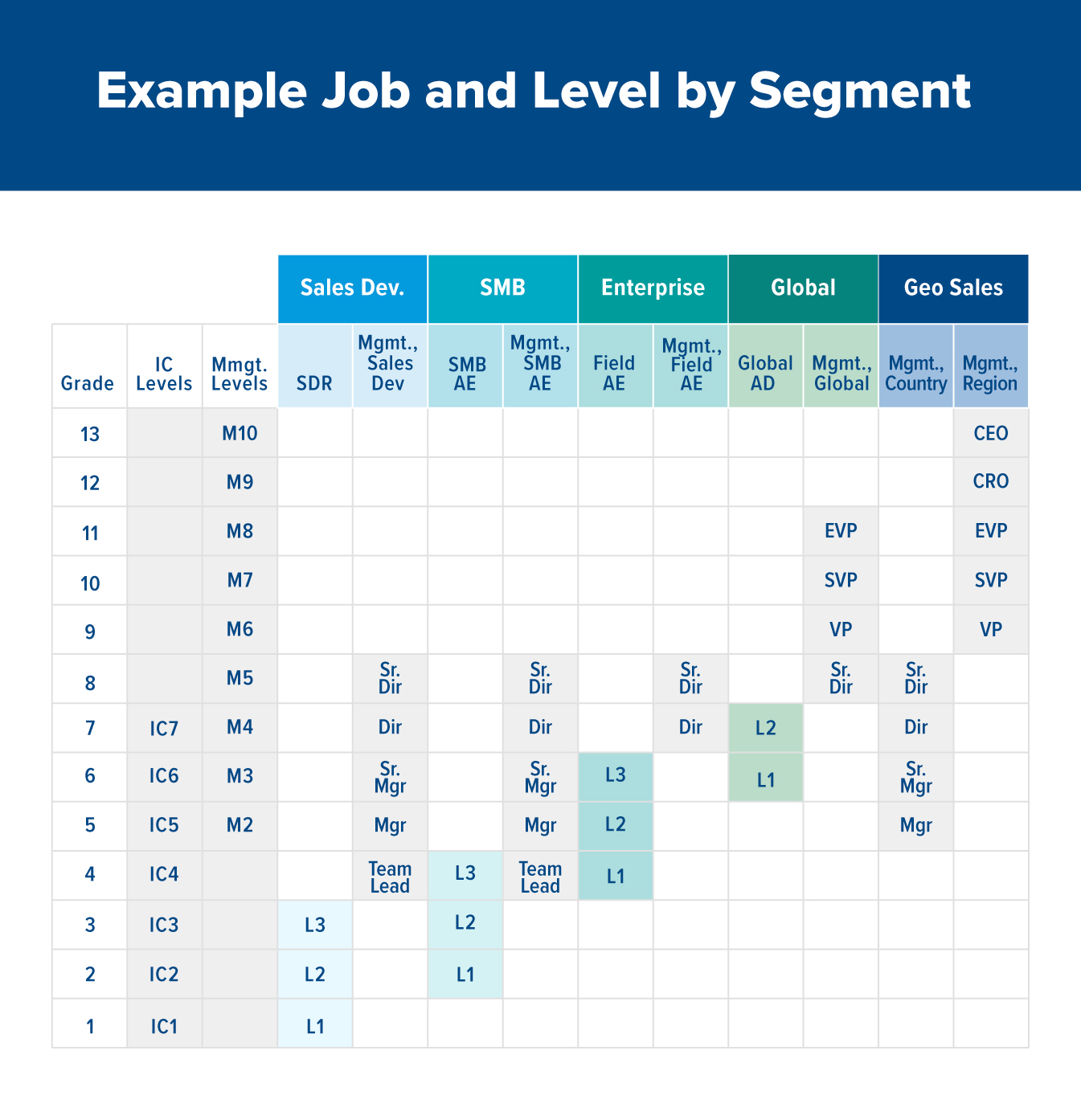
Job architecture is the framework of sales jobs and levels required to support the business. It should reflect both current job scope and expectations and how jobs may evolve as the business grows, ensuring the pay structure can scale with the organization. See figure below for an example of jobs and levels.
When creating pay structures, organizations should consolidate jobs that share the same market survey mapping or require similar skills and expertise into a common job family or pay structure group. For example, an organization can create a Sales TTC structure that includes grades 2 to 7 and use it for SMB AE, Enterprise AE and Global AD outlined in Figure 2. This approach creates a simpler and more scalable framework for managing pay structures.
8. Survey Mapping
Once the jobs and levels are confirmed, organizations should map them to the survey jobs and leveling structure provided by the pay survey vendor. If there is not a strong job market match, organizations can use internal equity comparisons to similar benchmarked jobs to determine how to price jobs without direct market data.
Bringing the Elements Together
Effective pay structure design requires more than market data. It requires a disciplined framework that connects pay philosophy, peer group selection, market data, pay ranges, geographic differentials, job architecture and survey mapping. When these elements are clearly defined, organizations can create sales pay structures that are market-aligned, internally consistent, transparent and scalable. Ultimately, companies who successfully implement this structure create a stronger foundation for pay decisions, talent strategy and long-term organizational growth.
Editor’s Note: Additional Content
For more information and resources related to this article, see the pages below, which offer quick access to all WorldatWork content on these topics:

#1 Total Rewards & Comp Newsletter
Subscribe to Workspan Weekly and always get the latest news on compensation and Total Rewards delivered directly to you. Never miss another update on the newest regulations, court decisions, state laws and trends in the field.