
For WorldatWork Members
- Checklist: Preparing U.S. Global Employers for EU Pay Transparency, Workspan Daily Plus+ article
- Answers to Common Employee Questions on Pay Transparency, Workspan Daily Plus+ article
- 5 Things TR Pros Can Do to Mitigate Pay Transparency Risks, Workspan Daily Plus+ article
- EU Pay Transparency Deadline Looms: Why Should Non-EU Companies Care? Workspan Magazine article
- Global Sales Compensation Made Simple, Workspan Magazine article
- Global vs. Localized Sales Compensation, Workspan Magazine article
- Pay Equity Laws by State — Are You in Compliance? tool
For Everyone
- The EU Pay Transparency Directive: The Reporting Isn’t the Hard Part, Workspan Daily article
- Are You Prepared for Pay Transparency? Most Aren’t. Workspan Daily article
- One Size Doesn’t Fit All: Solving Global Sales Comp with Local Insight, Workspan Daily article
- In Uncertain Times, Pursue Agility, Resiliency in Your Sales Comp Plan, Workspan Daily article
- Sales Compensation Course Series, education
- Navigating Multinational Sales Compensation, education
- Sales Comp ’26, conference


Across the European Union (EU), pay transparency is shifting from a policy discussion to a binding legal requirement. The EU Pay Transparency Directive introduces enforceable obligations that reshape how organizations recruit, pay, report on and ultimately defend compensation decisions. For sales organizations that use complex variable-pay programs linked to territories, products and quotas, this directive represents a particularly material change.
The EU Pay Transparency Directive expands beyond base salary to cover total remuneration, setting new standards for designing, documenting and explaining sales compensation programs. Leaders who treat this as a narrow compliance exercise risk exposure. Those who use it to strengthen compensation foundations can improve trust, consistency and talent outcomes.
What the Directive Is, and Why It Matters
The directive aims to close gender pay gaps and enforce the principle of equal pay for equal work or work of equal value. While reporting timelines vary by organization size, key transparency rights — particularly around recruitment and employee information — apply as soon as national legislation takes effect.
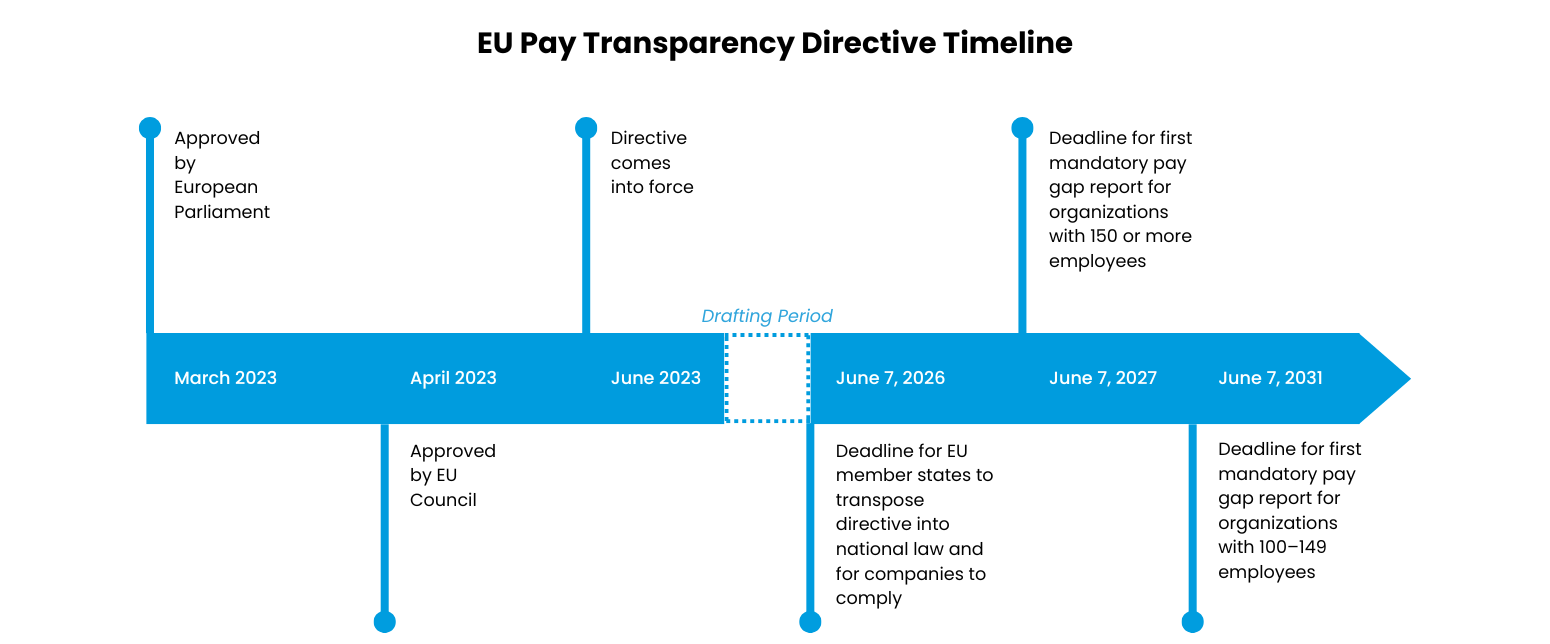
By June 7, 2026, every EU nation is required to establish its own law implementing the directive, outlining the essential principles, rights and employer obligations. However, the specific methods of application — how these rules are enforced and interpreted — are likely to evolve as laws, guidance and enforcement practices continue to develop.
Several aspects of the directive make it especially consequential for compensation leaders:
- The burden of proof shifts to employers. Organizations must be able to justify pay differences using objective, gender-neutral criteria. Employees no longer need to prove discrimination.
- Transparency extends beyond base pay. Bonuses, commissions, annual incentives, sales performance incentive funds (SPIFs), accelerators, benefits and other variable elements are in scope.
- Pay becomes an enforceable trust issue. Employees gain formal rights to request pay information and compare outcomes, accelerating scrutiny and dialogue.
Recruitment Transparency Comes First
Recruiting is where the directive is enforced earliest and most visibly. Employers must disclose either a single initial pay figure or a pay range before interviews take place, and they can no longer ask candidates about prior compensation. Job titles and postings must be gender neutral, and recruitment processes must be demonstrably nondiscriminatory.
For sales compensation, this raises some practical questions:
- Should organizations disclose base salary only or the total target compensation?
- Should they provide the full pay range or partial pay range typical for newer hires?
- Should they disclose the potential upside opportunity?
While the directive doesn’t prescribe exactly what elements must be shown, whatever is disclosed must align with internal pay structures and be defensible. Placeholder or inflated ranges, therefore, create risk. Published ranges that can’t be reconciled to actual pay decisions invite challenge and erode credibility with both candidates and employees.
Employee Information Rights Change the Conversation
Once employed, workers gain the right to request detailed information about their own pay and average pay levels (broken down by gender) for roles involving the same work or work of equal value. Employers must respond in writing within defined timeframes and provide clear, substantiated explanations.
For leaders, this marks a shift from informal, manager-led pay conversations to procedural, documented responses. Pay secrecy clauses are prohibited, and employees can’t be restricted from discussing compensation.
Sales organizations that rely on informal exceptions, manager discretion or inconsistent pay application will find these requests difficult to answer without friction.
Reporting and the 5% Pay Gap Trigger
The directive introduces regular gender pay gap reporting, with frequency based on organization size. Importantly, variable compensation is explicitly included in reporting metrics, alongside base pay.
If a gender pay gap exceeding 5% is identified for workers performing the same work or work of equal value — and can’t be objectively justified — a joint pay assessment with employee representatives is required. Corrective measures must be followed within a defined period.
A 5% threshold doesn’t guarantee protection or immunity — it’s a trigger that forces employers to demonstrate, using clear and objective logic, why differences exist. Central to this assessment is the “work of equal value” concept, which goes beyond job titles or organizational reporting lines.
Under the directive, work of equal value must be assessed using objective, gender-neutral criteria. This includes skills, effort, responsibility and working conditions. Roles that look different on the surface (e.g., different sales specializations, territories or deployment models) may still be deemed comparable if the underlying demands and contributions are equivalent. For sales organizations, the ability to consistently define, document and explain how roles compare across these dimensions is critical to justifying pay outcomes and defending against challenge.
Why Sales Compensation Is Under Greater Scrutiny
Sales compensation programs are often assumed to be inherently neutral because they reward measurable results. In practice, the directive broadens scrutiny beyond earnings to sales opportunity and access. Differences driven by quota difficulty, territory quality, hiring, and promotion practices or incentive mechanics are more likely to be challenged.
In addition, new-hire pay policies, midyear adjustments and exceptions all come into focus. Leaders must be able to explain not just what sellers earned but why those outcomes occurred.
Job Architecture Becomes the Compliance Backbone
One of the directive’s most significant implications is the elevation of job architecture from HR infrastructure to legal foundation. Clear job families, titles and levels (defined using objective, gender-neutral competencies/skills) are essential to determining work of equal value and defending pay differences.
Without robust job architecture, organizations will struggle to:
- Assess job comparability across functions or regions;
- Explain progression and career paths; and,
- Justify differences in pay levels, pay mix, quotas or upside.
High-Level Action Steps for Sales Compensation Leaders
Organizations don’t need to redesign everything at once, but they do need a deliberate, structured starting point. Effective preparation for sales compensation leaders should focus on the following sequence:
- Ensure effective governance and guiding philosophies are in place. Establish clear ownership, decision rights and principles across HR, legal, finance, sales and sales operations to manage pay transparency and equity consistently.
- Conduct a targeted audit to identify pay equity gaps and transparency risks. Assess current outcomes, historical decisions and data readiness to understand where exposure exists — particularly across variable pay and sales roles.
- Update go-to-market practices that impact pay transparency and equity, where needed. This may include refining job architecture, pay structures, sales compensation plan design and policies, as well as quota and territory-setting practices.
- Complete modelling and secure approvals. Test changes analytically, quantify impacts and align stakeholders before implementation.
- Build a change management strategy and rollout plan. Prepare leaders and managers for transparent communication, new processes and sustained adoption across the organization.
These steps shift the directive from a compliance exercise to a coordinated transformation effort, reducing risk while strengthening compensation credibility and trust.
Turning Compliance into Advantage
For sales compensation leaders, the directive isn’t just a regulatory hurdle. It’s a forcing mechanism that rewards clarity, consistency and disciplined design. These foundations reduce risk and support attraction, retention and sustainable performance in an increasingly transparent labor market.
Editor’s Note: Additional Content
For more information and resources related to this article, see the pages below, which offer quick access to all WorldatWork content on these topics:

#1 Total Rewards & Comp Newsletter
Subscribe to Workspan Weekly and always get the latest news on compensation and Total Rewards delivered directly to you. Never miss another update on the newest regulations, court decisions, state laws and trends in the field.