
For WorldatWork Members
- How to Reward Top Performers When Pay Raises Aren’t Possible, Workspan Daily Plus+ article
- If Workers Feel Squeezed, Reinforce the Sum Total of Your Rewards, Workspan Dily Plus+ article
- Perspective: Competitive Pay-to-Stay Wins Over Pay-for-Performance, Journal of Total Rewards article
- Navigating Living Wages in Total Rewards, Workspan Magazine article
- Compensation Philosophy Guide, tool
- Leveraging Job Descriptions for Effective Compensation, tool
For Everyone
- Report Results Smack of ‘Peanut Butter’ Pay Raise Approach for 2026, Workspan Daily article
- The ‘Salary Squeeze’: How the Workforce Is Weighing Compensation, Workspan Daily article
- Merit Reveal Season Is Here. Are Your Managers Ready to Talk Pay? Workspan Daily article
- The Power of Pay-for-Performance Sales Compensation Plans, Workspan Daily article
- Compensation Immersion Program, course
- 2025-2026 Salary Budget Survey, research


(Editor’s note: Lori Wisper is a faculty member for WorldatWork’s Compensation Immersion Program.)
Have you heard the latest on how best to reward annual salary increases by giving smaller increases that are spread like peanut butter? Some might say this method is the “anti-pay-for-performance” approach because it gives all employees in good standing the same increase rather than differentiating bigger increases for higher performers.
While salary increase budgets appear to be relatively stable (WTW reported a 3.5% average increase in the U.S. for 2026), some employers are considering following the path of companies like Starbucks, which gave a flat 2% to all North American salaried employees.
The fact that the coffeehouse chain’s shift in pay philosophy was part of a broader cost-containment effort to improve company performance should be considered, but it appears others are implementing this approach as a cost-effective alternative to the traditional (and highly criticized) merit pay method that’s been used in the U.S. since the mid-1970s.
Merit Pay Has Remained Unchanged for More Than 50 Years
Pay for performance originated in 1976 when WorldatWork (then known as the American Compensation Association) introduced the performance pay matrix, or merit matrix, to link individual performance ratings to base salary increases.
Prior to the merit matrix’s introduction, employers typically gave their employees general increases that were basically a condition of employment. That is, if you weren’t fired, you received the same salary increase as everyone else. At the time, average base salary increases were close to 10%, and bonuses were uncommon below the executive level. Performance reviews were more broadly used to manage large-scale employee populations and identify managers and future leaders.
Times have changed in the past 50-plus years. Organizations have grown, and salary budgets have shrunk, yet the merit pay process has remained virtually the same. Even as employees and managers (and even leaders) have pushed back on its effectiveness, the process of linking salary increases to performance ratings endures. That is, until last year, when Starbucks decided on the flat-rate plan, regardless of performance. So, is a “peanut butter” approach the only alternative?
Don’t Give Up on Pay for Performance; Just Do It Differently
Rather than giving up on the notion that you can more effectively link performance to pay, change the dynamic.
One way to do this is to think about the current state of pay for performance as if it were a funnel. There are performance inputs that go into the wide top of the funnel and pay outcomes that leak out the funnel’s bottom. The performance inputs are typically too broad to provide managers with enough direction to make good pay decisions because these inputs aren’t clearly aligned with the pay outcomes.
To improve the process, break the funnel model into cylinders to optimize clarity around what performance elements go best with certain pay elements (see the figure below). This can give managers better direction on how to define performance for the purposes of pay.
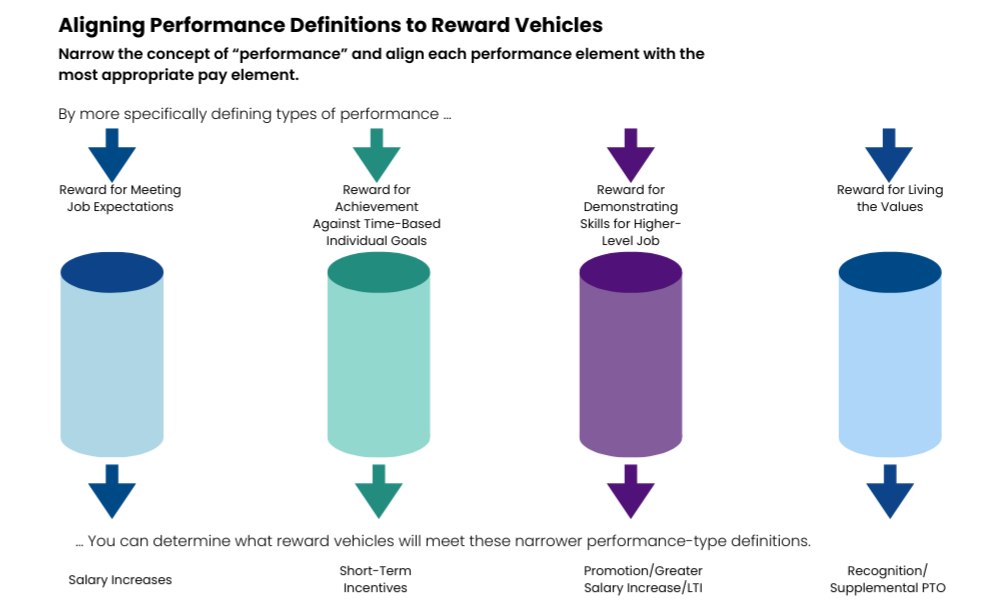
This approach can help you and the organization define performance in a much more granular way, enabling better pay decisions and more effective, transparent pay discussions with employees.
Performance is multidimensional, yet the common approach of one performance rating to encompass all dimensions for the purposes of pay has proved frustrating for managers and confusing for employees. The alternative to the peanut butter approach is to equip managers with effective decision tools that recognize all performance elements and then align those elements with the most appropriate pay vehicles.
Here’s how this could work:
- Tie salary increases to job-related performance only. Narrowing the holistic definition of performance to this first, most significant element allows you to tie it to a market rate for the job, which gives an anchor point for decision making. If the employee is performing the job as expected, pay should be close to the market rate.
- Only pay above market levels for demonstrating skills to do a different job. If a promotion isn’t feasible, pay the employee above market to retain those high-level skills.
- Consider the bigger picture. Define other performance elements for the purposes of short-term incentives (goal-based performance), long-term incentives (leadership performance) and recognition (values-based performance).
Organizations don’t have to give up the notion of paying for performance even as they realize:
- The standard merit pay method may no longer be merited; and,
- Peanut butter isn’t the only alternative approach.
Editor’s Note: Additional Content
For more information and resources related to this article, see the pages below, which offer quick access to all WorldatWork content on these topics:

#1 Total Rewards & Comp Newsletter
Subscribe to Workspan Weekly and always get the latest news on compensation and Total Rewards delivered directly to you. Never miss another update on the newest regulations, court decisions, state laws and trends in the field.