For WorldatWork Members
- Incentive Pay Practices, research
- Bonus Programs and Practices, research
- 2025-2026 Salary Budget Survey, research
- How to Reward Top Performers When Pay Raises Aren’t Possible, Workspan Daily Plus+ article
- Emphasize the Value of Total Rewards During Economic Uncertainty, Workspan Daily Plus+ article
- How to Identify the Linkages Between Performance and Pay, Workspan Daily Plus+ article
- Volatility-Proofing Your Incentive Rewards Strategies, Workspan Magazine article
- Incentives and Recognition: An Evidence Review, Journal of Total Rewards article
For Everyone
- Total Rewards ’26, conference
- Prioritizing Performance: How Might This Push Impact Pay Strategies? Workspan Daily article
- The Pros and Cons of Giving Managers Discretion on Merit Increases, Workspan Daily article
- Alignment, Market Competitiveness Are TR Leaders’ Top 2026 Priorities, Workspan Daily article
- Business Acumen and Communication Strategies in Total Rewards, course
- Base Pay Administration and Pay for Performance, course


“Frankly, we need to be honest about what is happening in organizations right now. From my vantage point as a total rewards leader, performance pay is increasingly disconnected from performance.”
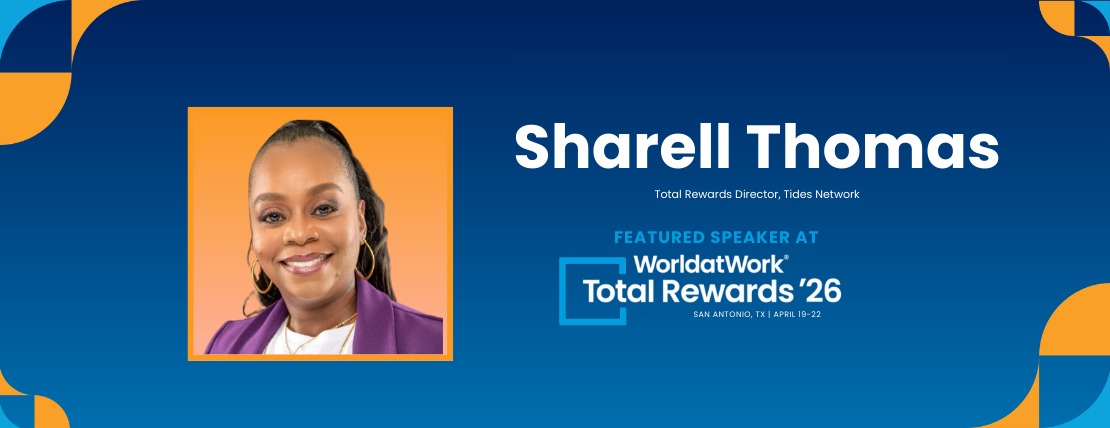
— Sharell Thomas, total rewards director, Tides Network
Incentives typically are meant to:
- Motivate employees;
- Reward/recognize their recent performance;
- Inspire meaningful behaviors;
- Reflect/reinforce corporate values; and,
- Strengthen team/organization collaboration.
Those boldfaced words are both positive and powerful. If that’s the case, why do incentive structures and outcomes land so poorly with some workers and organizations?
Sharell Thomas, the total rewards director at Tides Network, a San Francisco-based nonprofit and philanthropic organization, believes bonus programs are set up to either succeed or fail. She has found well-designed programs build trust, generate understanding and reinforce collaboration, while poorly designed systems do the opposite.
Thomas will share performance pay leading practices and lessons learned at WorldatWork’s Total Rewards ’26 conference, which runs April 19-22 in San Antonio, Texas.
In her April 20 session, titled “Bonuses Are Backfiring: Rethinking Performance Pay to Protect Culture,” she will challenge traditional performance pay structures and explore approaches that align recognition with organizational culture, fairness and sustainable engagement.
Workspan Daily editor Paul Arnold recently interviewed this HR leader on the current state of employee recognition … and what you can do about it. Her comments merit a read.
Check out Workspan Daily’s on-site coverage of Total Rewards ’26:
- There Is a Distinct Power in Knowing What Matters to Your Workers
- WorldatWork, HRCI Leaders Kick Off Program Exploring Work’s New Era
- Why Bravery Is a Formal Habit HR Pros Need to Build and Lean Into
- Cha-Ching: How to Transform HR into a Profit Center
Check out Workspan Daily pre-conference coverage on Total Rewards ’26:
- To Enhance Employee Experience, Lean into Integrity, ‘Radical Honesty’
- Conference Session Takes Community Approach to Solving HR Problems
- BIG Ideas: Learn How to Get the Most Out of a Small HR Budget and Team
- Hard Choices, Soft Solutions: A Considerate Approach to Compensation
- Making the Leap to a Pay-for-Performance Approach That Works
- Are You Speaking Gen Z’s Language When It Comes to Total Rewards?
Arnold: The title of your conference session is quite provocative. Please share your vantage point on the state of performance pay. What are you seeing?
Thomas: Frankly, we need to be honest about what is happening in organizations right now. From my vantage point as a total rewards [TR] leader, performance pay is increasingly disconnected from performance. Bonuses were designed to reinforce strategy and reward measurable impact. What I’m seeing instead is incentive fatigue, unclear metrics and payouts that feel either politically driven or financially constrained. When that happens, the bonus stops being motivational and starts eroding trust.
I’m also seeing three major trends:
- Organizations are layering on incentives without tightening the strategy. If goals are vague or constantly shifting, employees chase numbers instead of outcomes. That distorts behavior. People optimize for what is measured, not what actually moves the mission.
- Performance ratings and pay differentiation are getting softer. Many companies are afraid to truly differentiate, so everyone ends up clustered in the middle with small merit increases and watered-down bonuses. High performers feel unseen, average performers feel entitled and culture slowly drifts toward mediocrity.
- Transparency expectations are rising. Employees are more compensation-literate than ever. They are comparing notes, researching market data and questioning formulas. If the incentive plan is overly complex or inconsistently applied, credibility suffers.
My concern isn’t that bonuses are bad; it’s that poorly designed or poorly communicated performance pay systems can unintentionally undermine collaboration, psychological safety and long-term thinking. If incentives reward short-term wins over sustainable impact, culture pays the price.
My conference session will challenge leaders to ask a harder question: Is your performance pay driving the right behavior, reinforcing your values and protecting your culture, or is it quietly incentivizing the opposite?
Arnold: In your opinion, why are bonuses and other incentives not generating the intended results for some organizations and employees?
Thomas: I think bonuses and incentives fall short when they are treated as financial levers instead of behavioral strategy tools. A few core reasons behind this are:
- Misalignment. Incentives are often tied to metrics that don’t clearly connect to the organization’s mission or to the employee’s day-to-day work. When people can’t see how their effort meaningfully influences the outcome, the bonus feels random rather than motivating.
- Unclear line of sight. Many plans are too complex. Formulas, modifiers, scorecards and discretionary adjustments make it difficult for employees to predict or understand what drives payout. If I can’t clearly see how my behavior impacts my reward, the incentive loses power.
- Weak differentiation. In some organizations, everyone receives roughly the same payout regardless of performance level. High performers feel underrecognized, average performers feel validated and low performers feel insulated. Over time, this flattens performance culture.
- Short-term focus. Incentives often emphasize quarterly or annual numbers without reinforcing long-term health such as collaboration, innovation, talent development or risk management. People optimize for the metric, not the mission.
- Trust erosion. If bonus targets move midyear, leadership discretion overrides published criteria or financial constraints reduce payouts after goals were met, credibility declines. Once trust is broken, no incentive formula can fix it.
Bonuses are powerful when they are simple, aligned, transparent and anchored on values. They backfire when they are reactive, opaque or disconnected from culture. Incentives don’t just pay for results — they signal what truly matters. If that signal is unclear or inconsistent, performance will follow suit.
Arnold: What are some of the root causes of this problem?
Thomas: The bonus itself usually isn’t the issue; it’s typically the design and governance around it. Common causes include:
- Strategy misalignment. Incentives are built before the organization is clear on what truly drives success.
- Poor goal setting. Metrics are vague, constantly shifting or outside employees’ control.
- A lack of differentiation courage. Leaders avoid tough performance conversations, so pay doesn’t reflect impact.
- Complexity overload. Plans are so formula driven that employees can’t connect effort to outcome.
- Weak accountability. Midyear changes, discretion overrides or budget constraints undermine credibility.
When those foundations are shaky, even a well-funded incentive plan will struggle to produce the intended results.
Arnold: How can HR and TR professionals respond to this situation? What might an action plan look like? And, who from the organization all needs to be involved in this effort?
Thomas: To get started, some big-picture responses would include:
- Diagnose before redesign. Review payout data, performance distributions, turnover among high performers, engagement scores and goal-attainment patterns. Ask a simple question: Is this plan driving the behavior we intended?
- Simplify and realign. Tighten the number of metrics. Ensure every incentive measure connects directly to strategic priorities. If it doesn’t reinforce mission, margin or measurable impact, it likely doesn’t belong in the plan.
- Restore line of sight. Employees should be able to clearly articulate how their work influences payout. If they can’t explain it in plain language, the design is too complex.
- Strengthen differentiation and governance. Calibrate performance ratings. Align payout ranges with true contribution. Establish guardrails so midyear changes or discretionary adjustments don’t erode trust.
- Communicate with transparency. Share the “why” behind the plan, not just the formula. Incentives signal values. That signal must be intentional.
Regarding an action plan, from my perspective, it might look like this:
- Conduct a 60- to 90-day audit of current incentive design and outcomes.
- Facilitate executive working sessions to realign incentives with one to three core strategic priorities.
- Redesign metrics and weightings for clarity and behavioral alignment.
- Implement manager calibration training to improve performance differentiation.
- Launch a clear communication strategy with frequently asked questions and scenario examples.
- Establish annual review checkpoints to prevent drift.
This work can’t sit only with HR. Orchestrate:
- The executive team to align incentives with strategy and risk tolerance.
- Finance to validate funding models and sustainability.
- Business unit leaders to ensure operational relevance.
- People managers to drive performance accountability.
- HR and total rewards to design, model, govern and communicate.
Arnold: You state on your LinkedIn profile that “the most powerful leaders aren’t the loudest in the room — they’re the most strategic, the ones who understand timing, influence and identity.” What advice can you provide HR/TR leaders on considering, adopting and utilizing this mindset to address critical areas such as performance pay?
Thomas: To shape performance pay strategy, HR and TR leaders need to be prepared, data anchored and attuned to timing.
Here’s what the mindset looks like in practice:
- Be strategic about timing. Don’t challenge incentive design in the middle of budget lock. Bring insights before plan design begins. Use post-payout reviews and engagement data as entry points. Influence is strongest when it’s proactive, not reactive.
- Lead with data, not emotion. If bonuses are distorting behavior, show it. Use turnover data, rating distributions, compression analysis, payout variance and culture survey feedback. Executives respond to patterns and risk exposure more than opinion.
- Protect identity and culture. Every incentive plan communicates who the organization believes it is. If collaboration is a value but individual incentives reward siloed wins, there is an identity gap. HR leaders must be the guardians of that alignment.
- Ask sharper questions instead of making louder statements. For example: Are we rewarding what we say matters? Do our highest payouts reflect our highest impact? What behavior are we unintentionally incentivizing? Strategic influence is about framing the right questions so leadership reaches the right conclusions.
- Separate ego from impact. Performance pay conversations can become political. The goal isn’t to win the argument. The goal is to design a system that drives sustainable performance and protects culture.
When HR and TR leaders operate with clarity, timing and credibility, they shape decisions without needing to dominate the room. In performance pay, that quiet authority often creates the most durable change.
Check out Workspan Daily’s coverage of the Total Rewards ’25 conference:
- Might a Sales Mindset Be Your Key to Total Rewards Success?
- The Monumental Mission of Meaningful Mentorships
- Proactive TR Pros See ‘Train’ of Change Coming, Take Steps to Act
- The Keys to Creativity and Driving Innovative Total Rewards
- The Pros and Cons of Giving Managers Discretion on Merit Increases
- Using Analytics, Innovative Framework to Transform HR/Total Rewards
- How An Industry Leader Sees Technology Transforming Total Rewards
- Biopharma Compensation Leader Has Put AI Under the Microscope
Editor’s Note: Additional Content
For more information and resources related to this article, see the pages below, which offer quick access to all WorldatWork content on these topics:

#1 Total Rewards & Comp Newsletter
Subscribe to Workspan Weekly and always get the latest news on compensation and Total Rewards delivered directly to you. Never miss another update on the newest regulations, court decisions, state laws and trends in the field.