
For WorldatWork Members
- From Jobs to Skills to Outcomes: Leading the Evolution in Total Rewards, Workspan Dail article
- Why It’s Time for a Compensation Philosophy Refresh, Workspan Magazine article
- Two TR Leaders Provide a Personal Take on Their 2026 Priorities, Workspan Daily Plus+ article
- 2026 Priorities of Total Rewards Leaders, research
- Compensation Programs and Practices, research
- Salary Budget Planning: Using Market Data to Formulate a Recommendation Report, tool
- Compensation Philosophy Guide, tool
- Top Salary Budget Surveys, tool
- WorldatWork Career Center, jobs portal
For Everyone
- The Science and Art Behind Your Annual Salary Budget, Workspan Daily article
- What Are the Most Important HR Skills for 2027? Workspan Daily article
- Why HR Must Shift from Skills Management to Capability Design, Workspan Daily article
- Can You Guess the Top 10 Rising Skills for HR Professionals? Workspan Daily article
- What Are the Most Draft-Worthy Total Rewards Skills? Workspan Daily article
- Why a Fresh Compensation Philosophy Is Needed ... Now More Than Ever, Workspan Daily article
- So, You’re Taking Over Comp for the First Time. You Better Read This. Workspan Daily article
- 2026-2027 Salary Budget Survey, research
- WorldatWork Courses, education


“Our people tell us our pay isn’t competitive. Our managers say the salary structure is too rigid. And, finance wants us to control costs. How do we address this?”
It’s a familiar challenge for many HR and Rewards leaders.
The organization has grown. Roles have evolved. New skills have emerged. Some employees significantly exceed the market while others struggle to keep pace. Managers want more flexibility, employees want greater transparency and the business wants to remain financially disciplined.
You likely are tempted to start with the numbers: salary benchmarks, ranges, compa-ratios and budgets. But effective compensation strategy and design starts with a more fundamental question: “What should our compensation system achieve for the business and its workforce?”
This is where compensation strategy and design become a strategic capability — not simply a technical Rewards exercise.
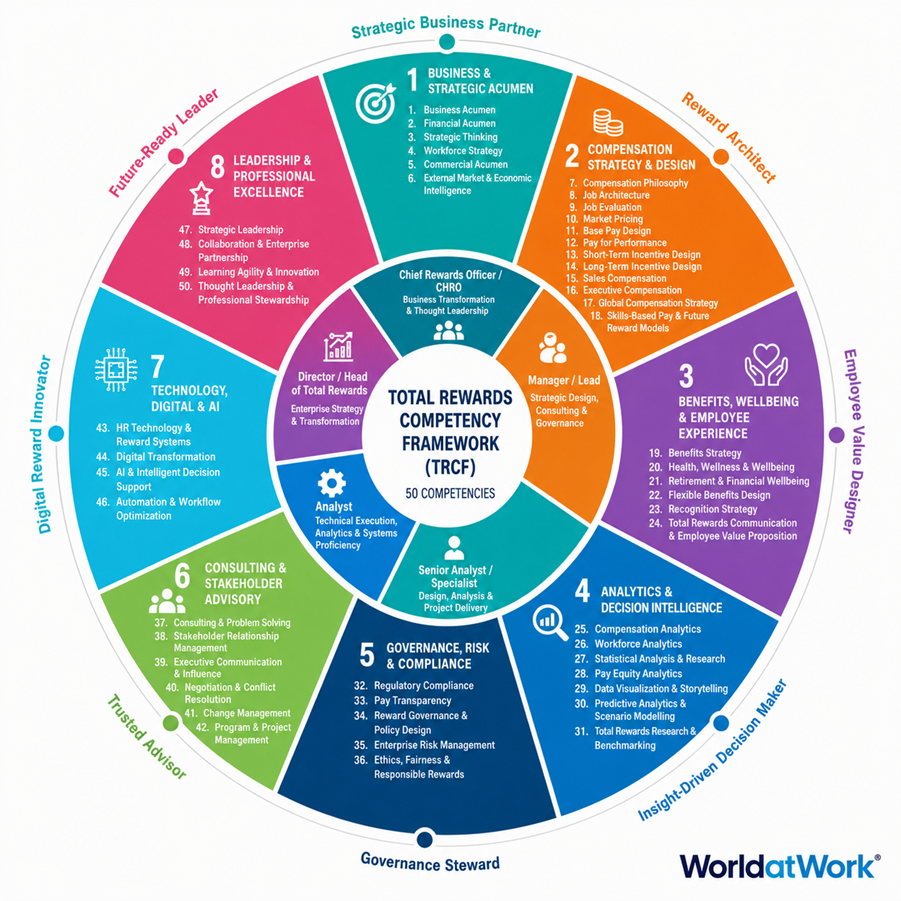
Access the articles in our Total Rewards Competency Framework series:
- A Primer on WorldatWork’s Total Rewards Competency Framework
- How to Use Our Rewards Framework as a Current-State Assessment Tool
- Rewards Competency: The Business and Strategic Acumen Domain
- Rewards Competency: The Benefits, Well-Being and Workforce Experience Domain (coming soon)
- Rewards Competency: The Analytics and Decision Intelligence Domain (coming soon)
- Rewards Competency: The Governance, Risk and Compliance Domain (coming soon)
- Rewards Competency: The Consulting and Stakeholder Advisory Domain (coming soon)
- Rewards Competency: The Technology, Digital and Artificial Intelligence Domain (coming soon)
- Rewards Competency: The Leadership and Professional Excellence Domain (coming soon)
From Salary Structures to a Compensation Strategy
WorldatWork’s Total Rewards Competency Framework (see above) identifies compensation strategy and design as one of its eight competency domains. The domain focuses on designing equitable, competitive and sustainable compensation programs aligned with business strategy. It includes competencies ranging from compensation philosophy and job architecture to market pricing, base pay, performance-based pay, incentives, executive compensation, global compensation and skills-based pay.
Consider an organization that has traditionally paid employees based largely on jobs and tenure. The business is now adjusting since:
- Skills are a key driver;
- Competition for critical talent is increasing; and,
- Employees expect clearer connections between contribution, career progression and pay.
Simply increasing salaries may address some immediate concerns, but it won’t necessarily address the underlying problem. The organization must understand what it wants its compensation system to encourage, recognize and sustain.
That’s the role of a compensation philosophy.
The Philosophy Behind the Numbers
A compensation philosophy provides the principles that guide pay decisions. For example, an organization may decide it wants to:
- Position pay competitively for critical talent;
- Differentiate rewards based on performance;
- Maintain internal equity;
- Recognize strategically important skills; and/or,
- Balance market competitiveness with financial sustainability.
These choices matter because compensation decisions rarely exist in isolation. An employer that wants to be highly competitive for scarce skills may make different market-positioning choices than one focused primarily on cost efficiency. Similarly, an employer seeking to strengthen a performance culture may need to examine whether its incentive design reinforces the behaviors and outcomes it wants.
The question, therefore, moves from “What should we pay?” to “What do we want our pay system to achieve?”
That distinction is at the heart of compensation strategy.
When the Structure No Longer Fits the Business
Managers are starting to question why two roles with very different responsibilities sit in the same grade. At this juncture, job architecture and job evaluation are important. A strong compensation strategy depends on having a clear understanding of jobs, their relative contribution and how they connect to career progression.
The objective is to create an architecture that helps the organization make consistent and explainable pay decisions, not simply to create more grades or job codes.
‘Market Competitive’ Doesn’t Mean ‘Market Driven’
External competitiveness is another part of the equation. Market pricing helps organizations understand how their pay compares with relevant external markets. Compensation strategy, though, is about more than matching a survey number. Ask yourself:
- What market is relevant for what talent for what roles and at what percentile?
- And, how much variation should there be based on business criticality, skills or location?
These are strategic choices. For example, an organization may choose to position certain critical roles differently from its broader workforce because the external talent market is significantly more competitive. Market pricing and compensation strategy come together here.
Instead of focusing on being “above market” or “at market” everywhere, the goal is to determine where market competitiveness matters most to the business.
Connecting Pay With Performance
The same principle applies to variable pay. An incentive plan can have perfectly designed mechanics and still fail to create the intended behavior. If an organization says it wants collaboration but rewards only individual performance, what message does the compensation system send? If it wants sustainable growth but heavily rewards short-term revenue, what behaviors would that encourage? If it wants innovation but penalizes reasonable experimentation through rigid performance measures, what might employees conclude?
Here, performance and incentive design become strategic. By going beyond “a correctly calculated incentive plan,” the focus is on the measures, weightings and payout opportunities that reinforce organization-valued outcomes and behaviors.
Compensation design should, therefore, begin with the business outcomes and work backward to the reward mechanics.
The New Model for Compensation Professionals
The compensation world also is changing. Consider that:
- Skills-based organizations are challenging traditional approaches to jobs and career progression.
- Global workforces create greater complexity in compensation design.
- Executive and sales compensation require increasingly specialized considerations.
- Organizations are balancing competitiveness, equity, transparency and cost.
WorldatWork’s competency framework, therefore, includes skills-based pay and future reward models as part of the compensation strategy and design domain, reflecting the need to think beyond traditional job-based approaches.
For pros like you, this means technical expertise remains essential, but it must be combined with the ability to understand how different compensation system elements work together. That’s because:
- A salary structure shouldn’t be viewed separately from job architecture.
- Market positioning shouldn’t be viewed separately from compensation philosophy.
- Incentive design shouldn’t be viewed separately from business strategy.
- Pay decisions shouldn’t be viewed separately from employee expectations around fairness and transparency.
Move From Designing Pay to Designing a Pay System
That last section is perhaps the biggest shift in compensation strategy and design.
The goal isn’t just to produce the right salary ranges, incentive formulas or market-pricing analyses. It’s to build a compensation system that is:
- Aligned with the business;
- Equitable internally;
- Competitive externally;
- Sustainable financially; and,
- Responsive to changing workforce needs.
In reviewing your compensation program, ponder this question: “If an employee asked me why we pay this way, could I clearly explain the business logic, principles and tradeoffs?”
If the answer is yes, you are likely helping the organization translate its strategy into decisions about how people are valued, recognized and rewarded. That is a valuable strategic capability.
Editor’s Note: Additional Content
For more information and resources related to this article, see the pages below, which offer quick access to all WorldatWork content on these topics:

#1 Total Rewards & Comp Newsletter
Subscribe to Workspan Weekly and always get the latest news on compensation and Total Rewards delivered directly to you. Never miss another update on the newest regulations, court decisions, state laws and trends in the field.