
For WorldatWork Members
- From Jobs to Skills to Outcomes: Leading the Evolution in Total Rewards, Workspan Magazine article
- Get Hands-On to Build Your HR Skill Set in the Back Half of 2026, Workspan Daily Plus+ article
- The AI Fluency Roadmap: Moving You From End-User to Strategist, Workspan Daily Plus+ article
- Two TR Leaders Provide a Personal Take on Their 2026 Priorities, Workspan Daily Plus+ article
- 2026 Priorities of Total Rewards Leaders, research
- WorldatWork Career Center, jobs portal
For Everyone
- What Are the Most Important HR Skills for 2027? Workspan Daily article
- Why HR Must Shift from Skills Management to Capability Design, Workspan Daily article
- Can You Guess the Top 10 Rising Skills for HR Professionals? Workspan Daily article
- What Are the Most Draft-Worthy Total Rewards Skills? Workspan Daily article
- HR’s AI ‘Future’ Is Now; WorldatWork Can Help You Make the Most of It, Workspan Daily article
- WorldatWork Courses, education


The Rewards function is rapidly and continuously evolving in response to elements such as:
- Changing workforce expectations;
- Artificial intelligence (AI);
- Pay transparency;
- The rise of the skills-based organization; and,
- Global business transformation.
As organizations expand Rewards’ strategic role, there is an increasing need for a structured capability framework to define, develop and future-proof the profession.
WorldatWork’s Total Rewards Competency Framework (TRCF) provides a comprehensive model for you and your colleagues. It is comprised of eight competency domains and 50 core competencies that align with career progression, as well as learning pathways and professional certifications (including those provided by the association).
Access a related Workspan Daily article on this subject:
Background on the Framework
WorldatWork developed the TRCF by studying leading practices from global competency and capability models, including those from Aon, Korn Ferry, Marsh, the Society for Human Resources Management and WTW. It also incorporated emerging trends such as AI, analytics, pay transparency, skills-based organizations and workforce transformation.
While other frameworks focus on broad HR competencies, leadership capabilities or specific consulting methodologies, the TRCF provides a dedicated end-to-end competency framework for the Rewards profession. It uniquely integrates role-specific competencies with business outcomes, career architecture, and WorldatWork learning and certification pathways, creating a practical, future-ready framework that supports capability development, career progression and organizational learning.
Design Philosophy and Guiding Principles
The TRCF was intentionally designed around business capability rather than functional activities. Instead of describing what Rewards professionals do, the TRCF defines the capabilities required to perform successfully in an increasingly strategic and technology-enabled environment.
The framework is designed to be:
- Business aligned, connecting Rewards capabilities with business strategy.
- Future ready, incorporating emerging capabilities such as AI, analytics and skills-based rewards.
- Role based, supporting career progression, from analyst to chief rewards officer.
- Globally applicable, exhibiting relevance across industries, geographies and organizational sizes.
- Learning centric, enabling continuous professional development through WorldatWork learning and certifications.
Organizations can use it to:
- Define Rewards competency expectations.
- Build role-specific learning journeys.
- Support career development and succession planning.
- Align employee development with business priorities.
- Guide certification and continuous learning.
Note: The TRCF is intended as a reference framework. Organizations may adapt the competency domains, proficiency expectations and learning pathways based on their business strategy, operating model, industry and organizational maturity.
The Framework’s Construction
The framework (see the figure below) defines the knowledge, skills, behaviors and capabilities required for Rewards professionals to design and implement strategies that enable business performance, retain talent, ensure governance and create sustainable workforce value.
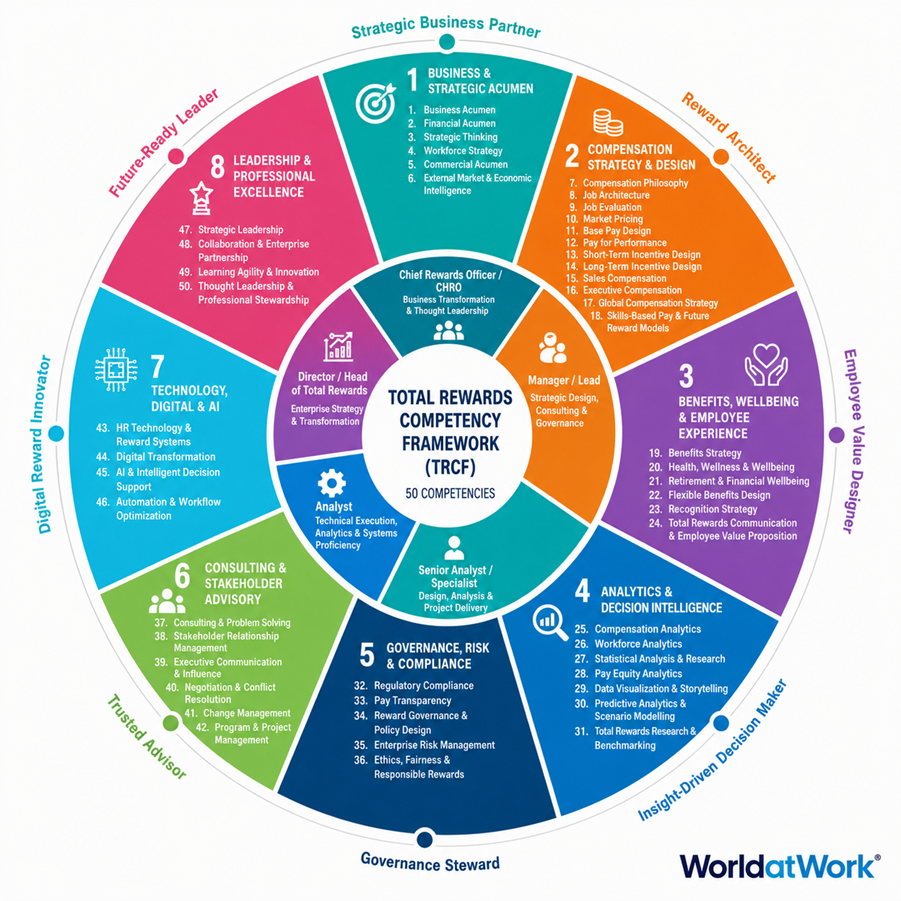
The table below lays out the architecture, in terms of domains and related competencies.
|
Domain |
Number of Related Competencies |
|---|---|
|
1. Business and Strategic Acumen |
6 |
|
2. Compensation Strategy and Design |
12 |
|
3. Benefits, Well-Being and Employee Experience |
6 |
|
4. Analytics and Decision Intelligence |
7 |
|
5. Governance, Risk and Compliance |
5 |
|
6. Consulting and Stakeholder Advisory |
6 |
|
7. Technology, Digital and AI |
4 |
|
8. Leadership and Professional Excellence |
4 |
|
Total |
50 |
Let’s explore this further by breaking it down, piece by piece.
Domain 1: Business and Strategic Acumen
The purpose here is to translate organizational strategy into Rewards strategies that drive organizational performance and workforce competitiveness.
|
No. |
Competency |
Business Outcome |
|---|---|---|
|
1 |
Business acumen |
Aligns rewards with business objectives |
|
2 |
Financial acumen |
Optimizes reward investment and return on investment (ROI) |
|
3 |
Strategic thinking |
Builds future-ready reward strategies |
|
4 |
Workforce strategy |
Aligns rewards with workforce planning |
|
5 |
Commercial acumen |
Balances cost, value and competitiveness |
|
6 |
External market and economic intelligence |
Anticipates labor market and economic shifts |
Aligned WorldatWork course: Business Acumen and Communication Strategies in Total Rewards
Aligned WorldatWork certification pathways: Certified Compensation Professional, Global Remuneration Professional
Domain 2: Compensation Strategy and Design
The purpose is to design equitable, competitive and sustainable compensation programs aligned with business strategy.
|
No. |
Competency |
Business Outcome |
|---|---|---|
|
7 |
Compensation philosophy |
Defines organizational pay principles |
|
8 |
Job architecture |
Creates scalable career frameworks |
|
9 |
Job evaluation |
Ensures internal equity |
|
10 |
Market pricing |
Maintains external competitiveness |
|
11 |
Base pay design |
Builds effective salary structures |
|
12 |
Pay for performance |
Links pay with performance outcomes |
|
13 |
Short-term incentive design |
Drives annual performance |
|
14 |
Long-term incentive design |
Supports retention and shareholder alignment |
|
15 |
Sales compensation |
Motivates revenue-generating roles |
|
16 |
Executive compensation |
Aligns leadership rewards with governance |
|
17 |
Global compensation strategy |
Supports multinational reward consistency |
|
18 |
Skills-based pay and future reward models |
Rewards capability rather than position |
Aligned WorldatWork courses: Creating Impact Through Total Rewards, Designing and Managing Base Pay Systems, Improving Performance With Variable Pay, Managing Global Total Rewards
Aligned WorldatWork certification pathways: Certified Compensation Professional, Global Remuneration Professional
Domain 3: Benefits, Well-Being and Employee Experience
The purpose is to create holistic reward programs that improve employee well-being, engagement and employer value proposition.
|
No. |
Competency |
Business Outcome |
|---|---|---|
|
19 |
Benefits strategy |
Competitive benefits portfolio |
|
20 |
Health, wellness and well-being |
Improved employee well-being |
|
21 |
Retirement and financial well-being |
Long-term employee security |
|
22 |
Flexible benefits design |
Personalized employee value |
|
23 |
Recognition strategy |
Improved engagement and performance |
|
24 |
Total rewards communication and employee value proposition |
Strong employee understanding and employer brand |
Aligned WorldatWork courses: Creating Impact Through Total Rewards, Certified Benefits Professional Bundle
Aligned WorldatWork certification pathways: Certified Benefits Professional, Certified Compensation Professional, Global Remuneration Professional
Domain 4: Analytics and Decision Intelligence
The purpose is to use evidence-based insights to optimize rewards decisions.
|
No. |
Competency |
Business Outcome |
|---|---|---|
|
25 |
Compensation analytics |
Better pay decisions |
|
26 |
Workforce analytics |
Data-driven workforce planning |
|
27 |
Statistical analysis and research |
Valid and reliable decision support |
|
28 |
Pay equity analytics |
Fair and equitable reward outcomes |
|
29 |
Data visualization and storytelling |
Executive-ready insights |
|
30 |
Predictive analytics and scenario modeling |
Future-focused decision making |
|
31 |
Total rewards research and benchmarking |
Market-informed strategies |
Aligned WorldatWork course: Compensation Analytics and Insights
Aligned WorldatWork certification pathways: Certified Compensation Professional, Global Remuneration Professional
Domain 5: Governance, Risk and Compliance
The purpose is to ensure legal compliance, governance, transparency and ethical reward practices.
|
No. |
Competency |
Business Outcome |
|---|---|---|
|
32 |
Regulatory compliance |
Legal adherence |
|
33 |
Pay transparency |
Increased trust and compliance |
|
34 |
Reward governance and policy design |
Consistent decision making |
|
35 |
Enterprise risk management |
Reduced financial and reputational risk |
|
36 |
Ethics, fairness and responsible rewards |
Sustainable reward practices |
Aligned WorldatWork course: Understanding the Total Rewards Regulatory Landscape
Aligned WorldatWork certification pathways: Certified Compensation Professional, Global Remuneration Professional
Domain 6: Consulting and Stakeholder Advisory
The purpose is to partner with business leaders to solve organizational challenges through strategic reward solutions.
|
No. |
Competency |
Business Outcome |
|---|---|---|
|
37 |
Consulting and problem solving |
Business-focused reward solutions |
|
38 |
Stakeholder relationship management |
Strong executive partnerships |
|
39 |
Executive communication and influence |
Improved decision quality |
|
40 |
Negotiation and conflict resolution |
Balanced reward outcomes |
|
41 |
Change management |
Successful reward transformation |
|
42 |
Program and project management |
Effective implementation |
Aligned WorldatWork course: Business Acumen and Communication Strategies in Total Rewards
Aligned WorldatWork certification pathways: Certified Compensation Professional, Global Remuneration Professional
Domain 7: Technology, Digital and AI
Leverage technology to improve efficiency, insight, and innovation in Rewards.
|
No. |
Competency |
Business Outcome |
|---|---|---|
|
43 |
HR technology and reward systems |
Efficient reward administration |
|
44 |
Digital transformation |
Modernized reward processes |
|
45 |
AI and intelligent decision support |
Faster, smarter reward decisions |
|
46 |
Automation and workflow optimization |
Increased operational efficiency |
Aligned WorldatWork course: AI Foundations for HR: Practical Skills for the Future of Work
Domain 8: Leadership and Professional Excellence
The purpose is to develop trusted advisors capable of leading the future of the Rewards profession.
|
No. |
Competency |
Business Outcome |
|---|---|---|
|
47 |
Strategic leadership |
Enterprise-level reward direction |
|
48 |
Collaboration and enterprise partnership |
Cross-functional integration |
|
49 |
Learning agility and innovation |
Continuous capability development |
|
50 |
Thought leadership and professional stewardship |
Advances the Rewards profession |
Aligned WorldatWork course: Creating Impact Through Total Rewards
Aligned WorldatWork certification pathway: Certified Senior Rewards Professional
|
Watch for Additional Articles on the Framework |
|
In the weeks and months ahead, Workspan Daily will publish even more articles on the Total Rewards Competency Framework to give you a better understanding of what it can teach you and your Rewards team. Upcoming articles will look further at how to apply each of the eight competency domains:
|
Editor’s Note: Additional Content
For more information and resources related to this article, see the pages below, which offer quick access to all WorldatWork content on these topics:

#1 Total Rewards & Comp Newsletter
Subscribe to Workspan Weekly and always get the latest news on compensation and Total Rewards delivered directly to you. Never miss another update on the newest regulations, court decisions, state laws and trends in the field.