
For WorldatWork Members
- From Jobs to Skills to Outcomes: Leading the Evolution in Total Rewards, Workspan Magazine article
- Get Hands-On to Build Your HR Skill Set in the Back Half of 2026, Workspan Daily Plus+ article
- The AI Fluency Roadmap: Moving You From End-User to Strategist, Workspan Daily Plus+ article
- Two TR Leaders Provide a Personal Take on Their 2026 Priorities, Workspan Daily Plus+ article
- 2026 Priorities of Total Rewards Leaders, research
- WorldatWork Career Center, jobs portal
For Everyone
- What Are the Most Important HR Skills for 2027? Workspan Daily article
- Why HR Must Shift from Skills Management to Capability Design, Workspan Daily article
- Can You Guess the Top 10 Rising Skills for HR Professionals? Workspan Daily article
- What Are the Most Draft-Worthy Total Rewards Skills? Workspan Daily article
- HR’s AI ‘Future’ Is Now; WorldatWork Can Help You Make the Most of It, Workspan Daily article
- WorldatWork Courses, education


“Can we reduce our people costs without putting our critical talent at risk?” It’s a question many Rewards leaders have heard.
Imagine a business facing slower growth and tighter financial expectations. The leadership team wants greater cost discipline, but it’s also investing in new capabilities and can’t afford to lose the talent needed to deliver its strategy.
This isn’t simply a question of salary budgets, market positioning or incentive design. It’s a business question, and answering it requires something increasingly important for Rewards professionals like you: business and strategic acumen.
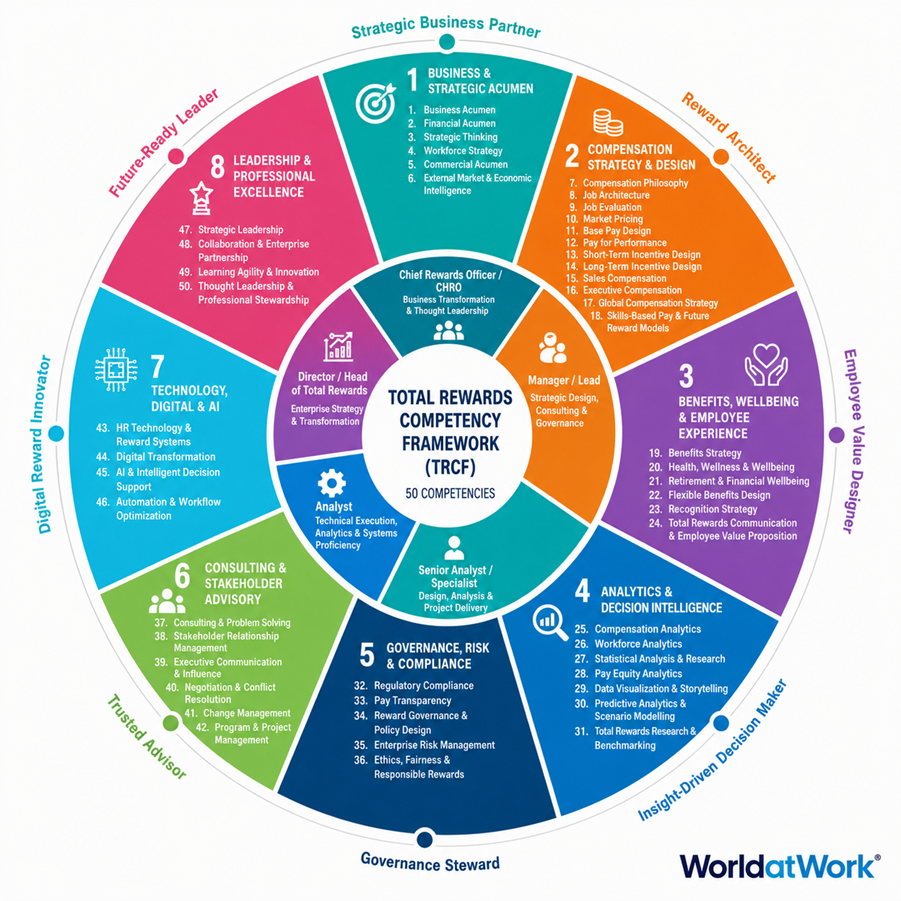
Access the articles in our Total Rewards Competency Framework series:
- A Primer on WorldatWork’s Total Rewards Competency Framework
- How to Use Our Rewards Framework as a Current-State Assessment Tool
- Rewards Competency: The Compensation Strategy and Design Domain (coming soon)
- Rewards Competency: The Benefits, Well-Being and Workforce Experience Domain (coming soon)
- Rewards Competency: The Analytics and Decision Intelligence Domain (coming soon)
- Rewards Competency: The Governance, Risk and Compliance Domain (coming soon)
- Rewards Competency: The Consulting and Stakeholder Advisory Domain (coming soon)
- Rewards Competency: The Technology, Digital and Artificial Intelligence Domain (coming soon)
- Rewards Competency: The Leadership and Professional Excellence Domain (coming soon)
From Rewards Program to Business Problem
WorldatWork’s Total Rewards Competency Framework (see figure above) identifies business and strategic acumen as one of eight competency domains. This domain has six competencies:
- Business acumen;
- Financial acumen;
- Strategic thinking;
- Workforce strategy;
- Commercial acumen; and,
- External market and economic intelligence.
Together, they are intended to help you translate organizational strategy into Rewards function strategies that support organizational performance and workforce competitiveness.
The shift sounds simple, but it changes the conversation.
A Rewards pro who approaches the issue only from a functional perspective might ask:
- Where are we over market?
- What is our salary budget?
- What programs can we change?
A strategically oriented Rewards pro, though, starts with different questions:
- What is the business trying to achieve?
- What capabilities are critical to that strategy?
- Where are our workforce risks?
- What are we prepared to invest in and why?
Understanding the Business Behind the Rewards Decision
Business acumen means understanding how the organization creates value, what drives its performance and where its strategic priorities lie.
For example, suppose the organization is trying to expand into new markets. That strategy may depend on a small number of critical skills that are already difficult to attract. At the same time, other parts of the workforce may have relatively stable talent requirements.
An across-the-board reduction in the rewards offered to employees might deliver an immediate financial saving. But, it also could create unintended consequences if it weakens the organization’s ability to attract or retain strategically important talent.
This is where workforce strategy becomes part of the conversation.
The question is no longer simply, “How much do we spend on rewards?” It becomes, “Where does our investment in rewards matter most to the business?”
That requires you to understand workforce segments, critical skills, talent availability and future workforce requirements, and then connect those insights to decisions about rewards.
Making the Business Case for Rewards
Strategic thinking also requires financial and commercial awareness.
Every rewards-based decision involves tradeoffs. Increasing investment in critical talent may improve competitiveness, but it has a cost. Reducing expenditure may improve short-term financial performance, but it could increase talent risk.
Financial acumen and commercial acumen matter here.
Rewards leaders need to be able to discuss the economics of their recommendations:
- The investment required;
- Potential value;
- Affordability;
- Competitiveness; and,
- The consequences of different choices.
They don’t necessarily need to become finance professionals. They do, however, need to be able to sit comfortably at the table with finance and business leaders and explain:
- What are we investing in?
- How much are we investing, and why?
- What outcome are we expecting?
- What are the tradeoffs?
That changes Rewards from a function that manages programs to one that helps the organization make workforce investment decisions.
Looking Beyond the Current Compensation Cycle
There’s another facet to strategic acumen: It’s looking ahead.
Labor markets change. Skills become scarce. Business models evolve. Technology reshapes roles. Economic conditions affect workforce costs. Employee expectations continue to change.
External market and economic intelligence can help Rewards professionals like you understand these shifts and determine which ones are likely to have meaningful implications for the organization. The WorldatWork framework links this competency to anticipating labor market and economic shifts, while strategic thinking is connected to building future-ready Rewards strategies.
The objective isn’t to respond to every market movement — it’s to recognize when an external shift should change the way the organization thinks about its workforce and the strategy for rewards.
For example, if the organization expects a significant increase in demand for a particular skill over the next three years, waiting until the talent market becomes highly competitive may be too late. Rewards may need to be part of the workforce strategy conversation much earlier.
What Does This Mean for You?
Business and strategic acumen is all about applying your Rewards expertise in a broader business context.
The most valuable rewards-centric conversations increasingly move beyond “Here is the market data” to “Here is what the business is trying to achieve, here is what it means for our workforce and here is how rewards can support that outcome.” That’s the progression from Rewards practitioner to strategic business partner.
The six competencies within this domain provide different lenses for making that shift:
- Understanding the business;
- Understanding the economics;
- Anticipating what’s ahead;
- Connecting rewards with workforce strategy;
- Balancing cost and value; and,
- Interpreting external market forces.
A useful test may be to ask one question whenever a new challenge arrives: “What business problem are we really trying to solve?”
The answer may reveal that “a better pay program” isn’t the simple solution. It may be a different workforce strategy, a different investment allocation or a different way of thinking about the role rewards plays in the business.
In this manner, business and strategic acumen becomes more than a competency on a framework. It becomes a way of practicing Rewards.
Editor’s Note: Additional Content
For more information and resources related to this article, see the pages below, which offer quick access to all WorldatWork content on these topics:

#1 Total Rewards & Comp Newsletter
Subscribe to Workspan Weekly and always get the latest news on compensation and Total Rewards delivered directly to you. Never miss another update on the newest regulations, court decisions, state laws and trends in the field.