

For WorldatWork Members
- Preparing for a Payroll Audit: A Federal Compliance Checklist, Workspan Daily Plus+ article
- Anatomy of a Wellness Program: Ensuring Regulatory Compliance, Workspan Daily Plus+ article
- Compliance Checklist When Vetting a New State for Business Expansion, Workspan Daily Plus+ article
- Two TR Leaders Provide a Personal Take on Their 2026 Priorities, Workspan Daily Plus+ article
- U.S. Compliance Poster Builder, tool
- 2026 Priorities of Total Rewards Leaders, research
- WorldatWork Career Center, jobs portal
For Everyone
- Wage-and-Hour Compliance: You Are Either Fine or Fined, Workspan Daily article
- Compliance Compendium: A Primer on the Family and Medical Leave Act, Workspan Daily article
- What’s Topping HR Leaders’ List of Workforce-Related Risks? Workspan Daily article
- Governance and Operations Are Foundational to Sales Comp Success, Workspan Daily article
- 2026 State of Rewards, research
- WorldatWork Courses, education


For many organizations, managing their employee rewards is becoming increasingly complex. Organizations must account for changing employment regulations, evolving pay transparency expectations, differences in local and international legislation, and growing scrutiny of how compensation decisions are made.
A company may have well-defined compensation structures, established benefits programs and documented incentive policies. It also may have HR and legal teams responsible for monitoring regulatory requirements. Yet, it’s an entirely different challenge to ensure all these elements operate within a consistent governance framework, manage organizational risk and reflect responsible practices.
Consider these questions:
- “Are our compensation and benefits programs compliant with applicable laws and regulatory requirements across the markets in which we operate?”
- “Can we explain how pay decisions are made and demonstrate they are fair, consistent and transparent?”
- “Do our rewards policies provide sufficient guidance for managers while allowing appropriate business flexibility?”
- “Are our incentive programs creating unintended financial, operational or reputational risks?”
- “How do we ensure rewards-related decisions reflect ethical principles and organizational values?”
These questions go beyond regulatory checklists and policy documentation. They require Rewards professionals like you to understand the regulatory environment, establish effective governance mechanisms, anticipate potential risks, and ensure that decisions are both defensible and responsible.
This is where governance, risk and compliance become essential capabilities in strategy design and deployment.
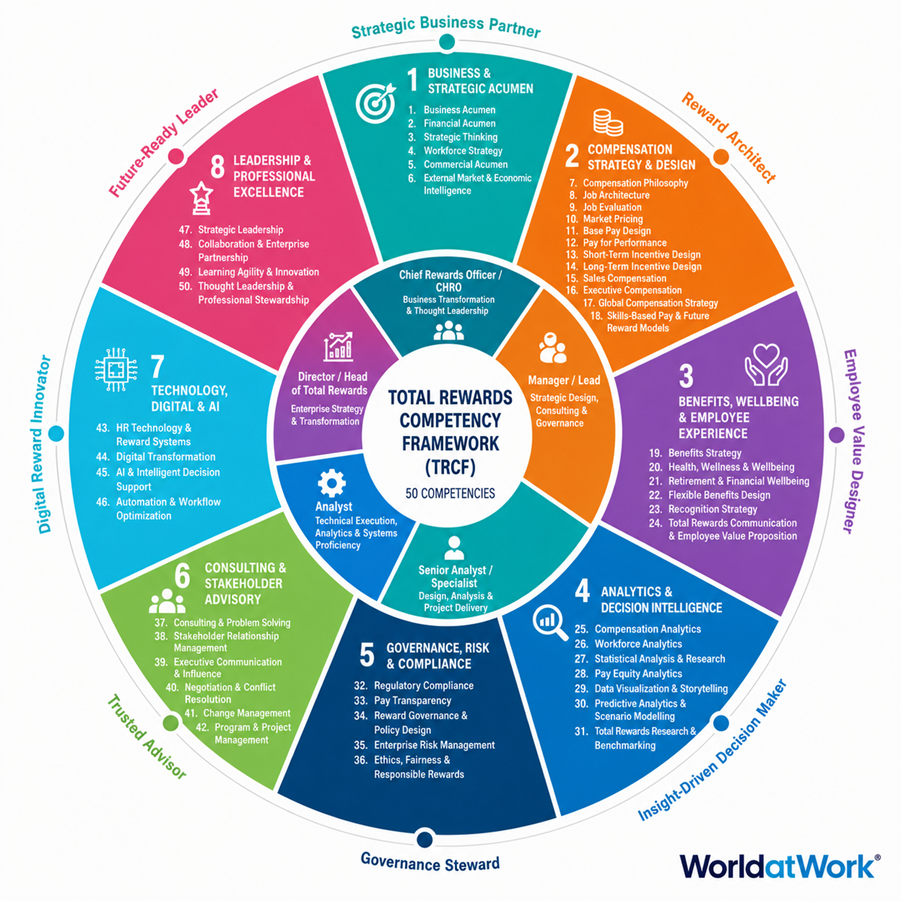
Access the articles in our Total Rewards Competency Framework series:
- A Primer on WorldatWork’s Total Rewards Competency Framework
- How to Use Our Rewards Framework as a Current-State Assessment Tool
- Rewards Competency: The Business and Strategic Acumen Domain
- Rewards Competency: The Compensation Strategy and Design Domain
- Rewards Competency: The Benefits, Well-Being, Employee Experience Domain
- Rewards Competency: The Analytics and Decision Intelligence Domain
- Rewards Competency: The Consulting and Stakeholder Advisory Domain (coming soon)
- Rewards Competency: The Technology, Digital and Artificial Intelligence Domain (coming soon)
- Rewards Competency: The Leadership and Professional Excellence Domain (coming soon)
From Rewards Administration to Governance and Accountability
WorldatWork’s Total Rewards Competency Framework (see above) identifies governance, risk and compliance as one of its eight competency domains. The domain focuses on ensuring legal compliance, governance, transparency and ethical practices.
It comprises five core competencies:
- Regulatory compliance;
- Pay transparency;
- Reward governance and policy design;
- Enterprise risk management; and,
- Ethics, fairness and responsible rewards.
Together, these competencies establish the foundation for managing rewards in a way that protects organizational interests while supporting employee trust and confidence.
Traditionally, rewards compliance has been viewed as a responsibility shared between HR, legal and payroll teams. However, as rewards strategies become more sophisticated and organizations operate across multiple jurisdictions, compliance and governance can no longer be treated as activities that happen only during audits or policy reviews.
Now, you must understand how:
- Regulatory requirements influence program design;
- Governance structures guide decisions; and,
- Potential risks can be identified before they become organizational challenges.
The shift is from simply ensuring rewards programs meet minimum requirements to building a governance framework that supports consistent, transparent and responsible decision making.
Understanding the Regulatory Landscape
Regulatory compliance is a fundamental requirement of any rewards strategy. Compensation, benefits, incentives and executive rewards are influenced by a wide range of employment, tax, labor and corporate regulations.
These requirements can differ significantly across countries, states and local markets. For multinational organizations, the complexity increases further as they must balance global principles with local legal requirements.
For example, an organization operating across several countries may have a globally defined compensation philosophy and incentive framework. However, differences in employment legislation/regulations, statutory benefits, tax treatment, working-time requirements and reporting obligations may require specific local adaptations.
You must understand these differences and work closely with your colleagues to ensure appropriate program design and administration.
An effective approach to regulatory compliance involves:
- Monitoring relevant legislative and regulatory developments;
- Understanding the implications of changes on existing rewards programs;
- Reviewing compensation, benefits and incentive policies periodically;
- Establishing appropriate controls and documentation; and,
- Partnering with internal and external experts to address complex compliance requirements.
Compliance shouldn’t be viewed as a one-time exercise. Regulatory expectations evolve, business operations change and new workforce arrangements introduce additional considerations.
Therefore, develop the ability to anticipate regulatory implications and incorporate compliance requirements into the rewards program design and management.
Making Pay Transparency a Strategic Priority
Pay transparency is becoming an increasingly important consideration for organizations as employees, candidates and regulators seek greater clarity around compensation practices. However, transparency involves much more than publishing salary ranges or communicating compensation policies. It requires organizations to establish a consistent and explainable approach to how pay decisions are made.
Consider an organization that introduces salary ranges across its job architecture. While the ranges provide employees and managers greater visibility, questions may arise around:
- Why employees performing similar roles receive different salaries;
- How individual pay is positioned within a salary range;
- What factors influence salary increases and promotions;
- How market competitiveness is considered in compensation decisions; and,
- What opportunities exist for employees to progress within their salary ranges.
Without consistent job architecture, reliable market data and clearly defined compensation principles, organizations may struggle to provide credible explanations.
You play an important role here.
Effective pay transparency requires organizations to establish clear compensation philosophies, maintain consistent job evaluation practices, conduct appropriate pay equity assessments and communicate the rationale behind compensation decisions.
It also requires managers to be equipped to have informed and constructive conversations about pay.
Transparency shouldn’t simply mean making more information available. Instead, it should enable employees to understand the principles, processes and considerations that influence their rewards.
When implemented effectively, pay transparency can strengthen employee confidence, support perceptions of fairness and help organizations meet evolving regulatory expectations.
Establishing Strong Governance Through Policies, Decision Rights
Rewards programs involve numerous decisions, ranging from salary adjustments and promotions to incentive payouts, retention awards and executive compensation. Without clearly defined governance structures, these decisions can become inconsistent across departments, business units and management levels.
For instance, consider an organization where managers have considerable flexibility to make compensation adjustments. While this flexibility may help address immediate talent requirements, it also can create challenges if approval processes, eligibility criteria and compensation guidelines aren’t clearly established.
Over time, similar roles may receive significantly different compensation outcomes, exceptions may become difficult to track and the organization may struggle to explain the rationale behind individual decisions.
Effective rewards governance helps prevent these situations by establishing clear principles, policies, accountability and decision-making authority.
Key considerations include:
- Compensation philosophy (establishing clear principles that guide how the organization approaches pay competitiveness, internal equity, performance differentiation and affordability);
- Policy design (developing consistent guidelines for salary administration, incentive eligibility, promotions, retention awards and other rewards decisions);
- Decision rights and accountability (defining who can recommend, review, approve and implement different types of compensation decisions);
- Exception management (establishing appropriate approval mechanisms and documentation requirements for decisions outside standard policies); and,
- Periodic reviews (evaluating whether policies remain relevant, effective and aligned with organizational priorities).
Rather than creating unnecessary layers of approvals or restricting business decisions, governance provides a structured approach that allows you and managers to make informed decisions within clearly established boundaries.
The objective is to balance business flexibility with consistency, accountability and control.
Managing Rewards Through an Enterprise Risk Perspective
Rewards decisions can create risks that extend well beyond compensation expenditure. Poorly designed incentive plans, inconsistent pay practices, inadequate controls or unclear governance can expose organizations to financial, legal, operational and reputational challenges.
For example, an incentive program designed primarily around short-term financial performance may unintentionally encourage behaviors that conflict with the organization’s longer-term objectives. Similarly, inconsistent compensation decisions across business units may create employee dissatisfaction, internal equity concerns and potential legal exposure.
Therefore, develop the ability to identify and assess risks across the entire portfolio.
An enterprise risk management perspective considers several dimensions:
- Financial risk (assessing the potential impact of compensation commitments, incentive payouts, benefit costs and long-term rewards obligations on organizational financial performance);
- Regulatory and legal risk (identifying potential exposure arising from noncompliance with applicable employment, compensation, benefits and disclosure requirements);
- Operational risk (evaluating weaknesses in rewards administration, approval processes, data management and internal controls);
- Reputational risk (understanding how perceived unfairness, controversial executive rewards decisions or inconsistent compensation practices may affect organizational credibility); and,
- Talent risk (recognizing how poorly designed rewards programs can influence employee trust, engagement, retention and the organization’s ability to attract critical talent).
Consider an organization reviewing its annual incentive plan. While the program may have successfully rewarded financial performance, you identify that certain performance measures could encourage excessive risk-taking or prioritize short-term results over sustainable business outcomes.
A more comprehensive review would examine the performance measures, payout thresholds, approval mechanisms and potential behavioral consequences of the plan. The organization then could introduce appropriate safeguards, strengthen oversight and ensure incentive outcomes remain aligned with broader business objectives.
This approach allows you to move beyond responding to risks after they occur and instead integrate risk assessment into program design and decision making.
Embedding Ethics, Fairness and Responsible Rewards
Compliance and governance provide the necessary structure for managing rewards. However, legal compliance doesn’t automatically mean every rewards decision is fair or ethically responsible. Organizations also must consider how their decisions affect employees, how consistently policies are applied and whether rewards practices reflect the values they communicate.
For instance, a compensation structure may technically comply with applicable regulations but still produce unexplained differences in pay between employees performing comparable work. Similarly, incentive programs may meet financial objectives while creating unintended consequences for employee well-being, collaboration or organizational culture.
Ethical and responsible rewards require you to look beyond whether a decision is permissible and consider whether it’s appropriate, equitable and sustainable. This involves:
- Evaluating compensation practices for potential bias and inequitable outcomes;
- Applying consistent and objective criteria when making rewards decisions;
- Ensuring performance and incentive measures encourage responsible behaviors;
- Protecting employee confidentiality and using rewards data responsibly;
- Communicating decisions honestly and consistently; and,
- Reviewing whether programs deliver outcomes aligned with organizational values.
Fairness doesn’t necessarily mean every employee receives the same rewards. Pay/incentive differences may be justified by various factors (e.g., role responsibilities, skills, experience, performance, market conditions).
Organizations, though, should be able to explain these differences through clear and consistently applied principles.
You have an important responsibility to ensure fairness is embedded in program design, administration and communication.
This is particularly important as organizations adopt more data-driven and technology-enabled approaches to compensation decisions. Responsible practices require appropriate oversight, attention to potential bias and clear accountability for the outcomes.
Ultimately, ethical rewards practices help strengthen employee trust and support the organization’s reputation as a fair and responsible employer.
Bringing Governance, Risk and Compliance Together
This domain’s five competencies are closely interconnected. Regulatory compliance establishes the requirements organizations must meet, while pay transparency supports openness and accountability. Governance and policy design create the structures through which decisions are made, enterprise risk management helps anticipate potential challenges, and ethical practices ensure rewards decisions reflect fairness and responsibility.
Consider an organization preparing to expand its operations into new markets. You must evaluate local compensation regulations, review statutory benefits requirements, assess pay transparency expectations and determine whether existing global policies can be applied consistently. At the same time, you must establish appropriate approval mechanisms, identify potential financial and operational risks, and ensure compensation decisions remain consistent with the organization’s fairness principles.
Addressing these considerations independently may lead to fragmented solutions. Bringing them together creates a more integrated governance approach.
Strengthen this capability by:
- Building awareness of regulatory developments relevant to the rewards portfolio;
- Establishing clear policies, decision rights and accountability mechanisms;
- Integrating risk assessment into program design and reviews;
- Using pay data and governance processes to support transparency and fairness; and,
- Partnering with legal, finance, compliance and business leaders to address emerging challenges.
The objective is to establish a structured approach that enables the organization to manage uncertainty, make defensible decisions and maintain confidence in its rewards practices.
When you understand regulatory requirements, establish effective governance, anticipate risks and embed ethical considerations into program design, you help protect the organization while strengthening employee trust.
From Compliance to Responsible Rewards Leadership
Governance, risk and compliance are sometimes viewed as control-oriented responsibilities that limit flexibility and create administrative complexity. However, their strategic value lies in enabling organizations to make better rewards decisions with greater confidence.
When you understand regulatory requirements, establish effective governance, anticipate risks and embed ethical considerations into program design, you help protect the organization while strengthening employee trust.
This capability becomes particularly important as organizations expand globally, respond to changing workforce expectations and face increasing scrutiny of compensation practices.
The defining question is no longer simply, “Are our rewards programs compliant?” Instead, it’s, “Are our rewards practices governed responsibly, designed fairly and equipped to manage the risks of a changing business environment?”
Editor’s Note: Additional Content
For more information and resources related to this article, see the pages below, which offer quick access to all WorldatWork content on these topics: