
For WorldatWork Members
- The Perception Gap: Managers and Employees View Rewards Differently, Workspan Magazine article
- A Graphic Look at WorldatWork’s State of Rewards Report, Workspan Magazine article
- It Starts With You: Make Well-Being a Personal Priority, Workspan Magazine article
- Meaning and Purpose Are Critical Pieces of the Rewards Puzzle, Workspan Magazine article
- Two TR Leaders Provide a Personal Take on Their 2026 Priorities, Workspan Daily Plus+ article
- Equity Audit: Are Your Benefits Meeting Employees at All Life Stages? Workspan Daily Plus+ article
- 2026 Priorities of Total Rewards Leaders, research
- WorldatWork Career Center, jobs portal
For Everyone
- How Benefits Define Culture and Drive Workforce Loyalty, Workspan Daily article
- Q&A: Experts Share What Benefits Trends Will Shape the Next 5 Years, Workspan Daily article
- For Many Employees, Benefits Matter as Much as (or More Than) Salary, Workspan Daily article
- What Are the Most Important HR Skills for 2027? Workspan Daily article
- Why HR Must Shift from Skills Management to Capability Design, Workspan Daily article
- Can You Guess the Top 10 Rising Skills for HR Professionals? Workspan Daily article
- What Are the Most Draft-Worthy Total Rewards Skills? Workspan Daily article
- 2026 State of Rewards, research
- WorldatWork Courses, education


Your organization has a comprehensive benefits portfolio. The workforce has access to medical coverage, wellness initiatives, retirement benefits and recognition programs. However:
- Employee participation in some initiatives remains low;
- A percentage of those workers admit they don’t always understand what is available to them; and,
- You and your HR teammates continue to hear concerns about stress, financial pressures and work-life balance.
Under these circumstances, the temptation is for Rewards leaders like yourself to introduce another benefit, expand an existing program or benchmark the organization’s offerings against competitors.
An effective benefits and well-being strategy, though, starts with a more fundamental, three-part question:
- What does your workforce value?
- What do they need?
- How can your Rewards strategy improve their experience while supporting business outcomes?
This is where benefits, well-being and employee experience becomes a strategic capability and not simply an exercise in managing benefits programs.
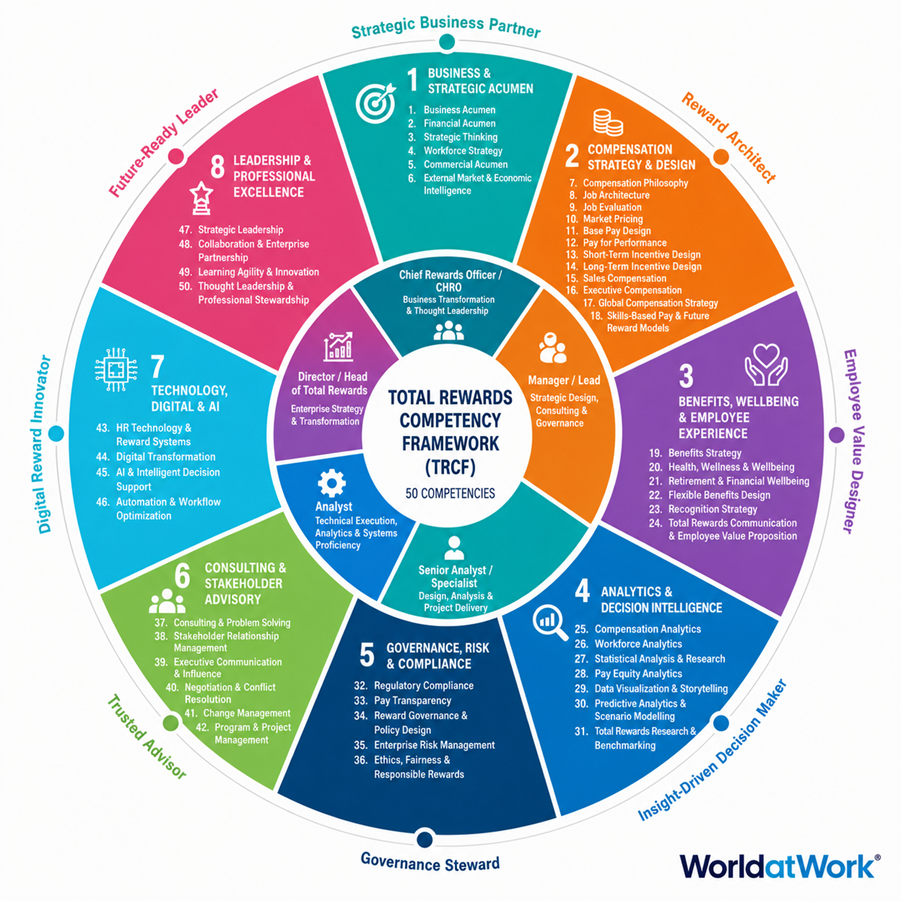
Access the articles in our Total Rewards Competency Framework series:
- A Primer on WorldatWork’s Total Rewards Competency Framework
- How to Use Our Rewards Framework as a Current-State Assessment Tool
- Rewards Competency: The Business and Strategic Acumen Domain
- Rewards Competency: The Compensation Strategy and Design Domain
- Rewards Competency: The Analytics and Decision Intelligence Domain (coming soon)
- Rewards Competency: The Governance, Risk and Compliance Domain (coming soon)
- Rewards Competency: The Consulting and Stakeholder Advisory Domain (coming soon)
- Rewards Competency: The Technology, Digital and Artificial Intelligence Domain (coming soon)
- Rewards Competency: The Leadership and Professional Excellence Domain (coming soon)
The Shift From Benefits Administration to Employee Value
WorldatWork’s Total Rewards Competency Framework (see above) identifies benefits, well-being and employee experience as one of its eight competency domains. The domain includes six competencies:
- Benefits strategy;
- Health, wellness and well-being;
- Retirement and financial well-being;
- Flexible benefits design;
- Recognition strategy; and,
- Total rewards communication and employee value proposition.
Together, these competencies focus on creating holistic rewards programs that seek to positively address employees’ feelings that:
- They are cared for; and,
- There is a tangible personal return for their work efforts.
When those feelings are indeed positive, it typically bears itself out in strong engagement, motivation and retention.
Consider an organization whose benefits portfolio has expanded over several years. Each new initiative was introduced with good intentions: Health coverage was enhanced, wellness activities were added and employees were given more choices through flexible benefits. However, the organization never has stepped back to assess whether these offerings reflect the workforce’s changing needs. Consider that:
- Younger employees may be looking for financial flexibility and career-related support.
- Employees with families may place greater value on health coverage and caregiving support.
- Employees approaching retirement may prioritize long-term financial security.
- Others may value flexibility, mental well-being or recognition for their contributions.
A single benefits proposition may not deliver equal value to everyone.
The challenge, therefore, isn’t necessarily to offer more — it’s to understand what benefits create meaningful value for different employee populations and why.
Designing Benefits Around Workforce Needs
A strong benefits strategy begins with understanding the workforce and the organization’s priorities.
Demographics, life stages, workforce locations, talent markets and business requirements all can influence how employees perceive and use benefits. Listening to these workers, examining utilization patterns and understanding emerging workforce needs can help you identify where existing programs are working and where they may need to evolve.
For example, you may discover employees appreciate your health insurance offering but struggle to understand the range of benefits available to them. Or, you may find wellness initiatives generate interest but do little to address the underlying pressures employees experience at work. These findings call for different responses.
In the first instance, you may need clearer communication and easier access to benefits. In the second, you may need to look beyond wellness activities and examine workload, manager practices, flexibility and the broader employee experience.
This is where benefits strategy and health, wellness and well-being come together. The real objective is to create an approach that responds to employee needs and supports sustainable workforce performance.
The Importance of Financial Well-Being, Flexibility and Recognition
The definition of employee value continues to evolve. Employees may appreciate competitive pay, but their rewards experience also is shaped by financial security, flexibility, recognition and the extent to which the organization responds to their circumstances.
Financial well-being is an important dimension. Rising living costs, financial commitments and uncertainty about the future can influence how employees experience their rewards package. Retirement benefits and financial well-being initiatives can play a role in helping employees build greater financial security.
Flexible benefits design offers another opportunity. Rather than assuming every employee values the same benefits equally, consider how to provide meaningful choices within your financial and operational constraints. The objective is to balance personalization with affordability, fairness and ease of administration.
Recognition is equally important. You may invest substantially in formal reward programs but overlook the everyday experiences that influence whether employees feel valued. Recognition practices that are timely, meaningful and aligned with organizational values can help reinforce desired contributions and behaviors.
The Value of Benefits Depends on How Employees Experience Them
Flexibility and choice alone don’t guarantee a better employee experience. Rewards programs should be accessible, understandable and relevant. Therefore, you need to consider what is offered and how employees experience it.
Imagine an organization offering a generous benefits package that employees struggle to understand. The benefits may be competitive on paper, but their perceived value can be much lower if employees don’t understand:
- If/when they are eligible;
- How to access them; or,
- How the offerings support their needs.
It’s here that communication and value proposition become critical.
Your communications should do more than announce benefits during open enrollment. They should help employees understand the value of the overall Rewards offering and how the different elements work together. Clear communication can make it easier for employees to recognize the value of benefits, make informed choices and connect the organization’s investment with their own needs.
The employee experience also extends beyond communication. Enrollment processes, access to support, manager conversations and the consistency of benefits delivery all influence employee perceptions.
So, look at the complete experience — not just the design of individual programs.
Your Challenge, Your Opportunity
Your challenge is to bring all of these elements together into a coherent strategy. Now, consider how you might:
- Make benefits relevant to workforce needs.
- Administer well-being initiatives in the context of the wider employee experience.
- Balance flexibility with affordability and operational feasibility.
- Utilize recognition to reinforce the contributions and behaviors the organization values.
- Communicate in a way that the overall proposition is understandable and meaningful.
Editor’s Note: Additional Content
For more information and resources related to this article, see the pages below, which offer quick access to all WorldatWork content on these topics: