
For WorldatWork Members
- Considerations When Applying AI to People Analytics, Workspan Daily Plus+ article
- How’s Your Data Hygiene? Conduct a Validation Audit to Find Out, Workspan Daily Plus+ article
- Two TR Leaders Provide a Personal Take on Their 2026 Priorities, Workspan Daily Plus+ article
- A Graphic Look at WorldatWork’s State of Rewards Report, Workspan Magazine article
- Meaning and Purpose Are Critical Pieces of the Rewards Puzzle, Workspan Magazine article
- Guided Checklist for Analytic Thinking & Data-Driven Action in Total Rewards, tool
- 2026 Priorities of Total Rewards Leaders, research
- WorldatWork Career Center, jobs portal
For Everyone
- Using Analytics, Innovative Framework to Transform HR/Total Rewards, Workspan Daily article
- What Are the Most Important HR Skills for 2027? Workspan Daily article
- Why HR Must Shift from Skills Management to Capability Design, Workspan Daily article
- Can You Guess the Top 10 Rising Skills for HR Professionals? Workspan Daily article
- What Are the Most Draft-Worthy Total Rewards Skills? Workspan Daily article
- 2026 State of Rewards, research
- WorldatWork Courses, education
- Insights & Analytics Tech Demo Day, Dec. 1 webinar


“Are we getting the right return on our rewards investment?”
For many organizations, this seemingly straightforward question is surprisingly difficult to answer. A company may know exactly how much it spends on employee compensation, how its salaries compare with market benchmarks and how much it distributes through annual incentives. It also may track employee turnover, engagement scores and benefits utilization. Yet, bringing these measures together to understand how rewards decisions influence workforce and business outcomes is an entirely different challenge.
Consider:
- Does higher compensation spending translate into stronger retention?
- Are incentive plans encouraging the performance and behaviors the business needs?
- What rewards investments deliver the greatest value, and where might resources be better allocated?
These questions can’t be answered through reporting alone. They require Rewards professionals to interpret data, test assumptions, evaluate alternatives and translate evidence into actionable business decisions.
This is where analytics and decision intelligence become essential to the strategic practice of Rewards.
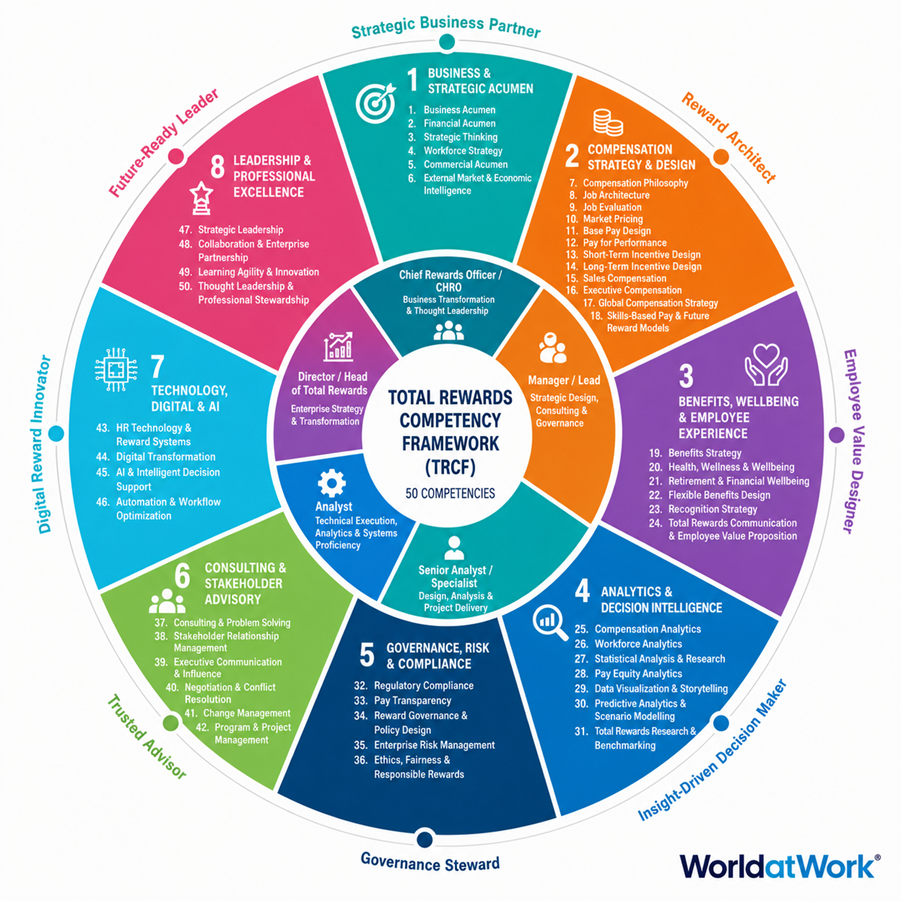
Access the articles in our Total Rewards Competency Framework series:
- A Primer on WorldatWork’s Total Rewards Competency Framework
- How to Use Our Rewards Framework as a Current-State Assessment Tool
- Rewards Competency: The Business and Strategic Acumen Domain
- Rewards Competency: The Compensation Strategy and Design Domain
- Rewards Competency: The Benefits, Well-Being, Employee Experience Domain
- Rewards Competency: The Governance, Risk and Compliance Domain (coming soon)
- Rewards Competency: The Consulting and Stakeholder Advisory Domain (coming soon)
- Rewards Competency: The Technology, Digital and Artificial Intelligence Domain (coming soon)
- Rewards Competency: The Leadership and Professional Excellence Domain (coming soon)
From Rewards Reporting to Strategic Decision Making
WorldatWork’s Total Rewards Competency Framework (see above) identifies analytics and decision intelligence as one of its eight competency domains. The domain highlights the importance of using data, analytical methods and evidence-based insights to guide decisions about rewards.
Although reporting and analytics are closely related, they serve different purposes.
- Reporting helps organizations understand what has happened.
- Analytics helps explain patterns, investigate potential causes and assess what might happen next.
Decision intelligence builds on these capabilities by helping leaders evaluate alternatives, understand tradeoffs and determine the most appropriate course of action.
Consider an organization experiencing rising employee turnover despite offering competitive compensation packages. Its Rewards team produces monthly dashboards showing attrition rates, salary positioning and employee engagement scores. These reports provide useful information, but they don’t necessarily explain why employees are leaving or what interventions would be most effective.
A more analytical approach would examine turnover across critical roles, business units, tenure groups and performance levels. The team could assess whether compensation positioning is associated with attrition and investigate how career progression, manager effectiveness and employee perceptions of fairness might influence retention.
The findings could reveal compensation is a significant concern among employees in certain critical skill roles while limited career opportunities are more closely associated with turnover in other groups.
The organization could then consider targeted salary adjustments for the first group and career development interventions for the second, rather than applying a uniform solution across the workforce.
The shift is significant when Rewards professionals move from reporting workforce outcomes to helping the business understand its options and make informed decisions.
Asking the Right Questions Before Analyzing the Data
Effective analytics begins with a clearly defined business question, not with the availability of data or the selection of an analytical tool.
Rewards teams can access information from multiple sources, including compensation databases, performance management systems, employee surveys, benefits platforms, recruitment records and workforce planning tools. However, more data doesn’t automatically produce better decisions. Without a clear objective, organizations can spend considerable time generating reports that offer little practical value.
A useful starting point is to identify the business problem and determine what evidence would help resolve it.
For example, if an organization wants to improve the effectiveness of its annual incentive plan, the Rewards team might ask:
- Are the performance measures in the incentive plan aligned with the organization’s strategic priorities?
- Do employees and managers understand how performance translates into incentive outcomes?
- Are incentives encouraging the desired behaviors, or are they creating unintended consequences?
- How do incentive costs compare with the financial and operational outcomes the plan is designed to support?
Each question requires different information and analytical methods. Together, they help the organization move beyond simply reviewing incentive expenditure toward evaluating whether the plan is working as intended.
This approach also helps Rewards professionals prioritize their analytical efforts. Rather than measuring everything that can be measured, they can concentrate on the questions where better evidence is most likely to improve a business decision.
Building a Foundation for Reliable Rewards Analytics
The quality of an analytical insight depends on the quality of the underlying data, the methods used to interpret it and the context in which the findings are applied.
For Rewards professionals, this means understanding the strengths and limitations of different data sources and ensuring information can be interpreted consistently across the organization.
For example, compensation analysis may be compromised if job titles are used as substitutes for properly evaluated roles, market benchmarks aren’t matched to comparable positions or employee populations are defined differently across business units. Similarly, attrition analysis can become misleading when voluntary and involuntary turnover are combined or when comparisons fail to account for differences in workforce composition.
Before drawing conclusions, Rewards teams should establish consistent definitions, validate data quality and understand the assumptions behind their calculations.
They also must distinguish between correlation and causation. If employees receiving higher bonuses demonstrate stronger retention, it doesn’t automatically follow that the bonuses caused them to stay. Differences in job level, career opportunities, performance or manager quality also may influence retention.
Analytical rigor requires professionals to investigate these relationships carefully, recognize limitations and avoid presenting associations as proven causes.
Equally important is the ability to interpret findings in the context of business strategy. A compensation investment that appears expensive in isolation may be justified if it addresses a critical talent shortage or reduces the operational disruption associated with losing scarce skills. Conversely, a program with relatively low expenditure may still represent poor value if it doesn’t achieve its intended objectives.
Reliable analytics combines sound data practices with business understanding and professional judgment.
Moving From Descriptive Analytics to Decision Intelligence
Organizations can strengthen their analytical capabilities by progressing from understanding past outcomes to evaluating future choices. Four complementary stages illustrate this progression.
Descriptive Analytics: What’s Happening?
Descriptive analytics establishes a baseline by summarizing workforce and rewards information. Common examples include:
- Compensation expenditure;
- Salary positioning against market benchmarks;
- Employee turnover;
- Benefits participation; and,
- Incentive payouts.
These measures help Rewards leaders understand current conditions and identify areas requiring attention. However, they rarely explain the underlying reasons for a result or determine what should happen next.
Diagnostic Analytics: Why Might It Be Happening?
Diagnostic analytics investigates the factors associated with observed outcomes. A Rewards team might examine whether:
- Turnover is concentrated among employees whose salaries fall below relevant market benchmarks;
- Incentive outcomes vary substantially across business units; or,
- Benefits utilization differs across workforce segments.
The findings can help identify plausible explanations and determine where further investigation is needed. Conclusions should reflect the strength of the evidence rather than assume every observed relationship represents a direct cause.
Predictive Analytics: What Might Happen Next?
Predictive analytics uses historical information and relevant variables to estimate future outcomes. For example, an organization might forecast compensation costs under different workforce growth scenarios, estimate the potential financial implications of salary adjustments or identify employee groups with an elevated attrition risk.
Such estimates can support workforce planning and scenario analysis. However, predictions aren’t certainties. Their reliability depends on data quality, model assumptions and the extent to which future conditions resemble those reflected in historical data.
Decision Intelligence: What Should We Do?
Decision intelligence brings the analysis together to support a specific choice.
Imagine an organization has a limited compensation budget and needs to address retention challenges across several business units. Leaders could compare a broad-based salary increase with targeted adjustments for critical roles, changes to incentive design, or a combination of financial and nonfinancial interventions.
Each option can be evaluated against its expected cost, potential workforce impact, internal equity implications, implementation requirements and alignment with business priorities.
The Rewards team then can present the available alternatives, explain the assumptions behind each scenario and recommend an approach based on the evidence.
This doesn’t mean every decision can be reduced to a numerical formula. Employee trust, organizational culture, fairness and long-term capability also matter. Decision intelligence helps leaders make these tradeoffs more explicitly rather than relying solely on intuition or established practice.
Connecting Rewards Analytics to Business Outcomes
The strategic value of analytics becomes clearer when Rewards professionals connect their findings to outcomes that matter to the organization.
This approach can be applied across the rewards portfolio, including:
- Compensation. Assess whether pay investments support talent attraction, retention, internal equity and the organization’s talent strategy.
- Benefits and well-being. Examine whether programs are accessible, valued and associated with the intended employee outcomes.
- Recognition. Evaluate whether recognition practices reach the intended populations and reinforce behaviors the organization values.
- Executive and sales compensation. Assess whether incentive structures align individual and leadership decisions with sustainable business performance.
- Workforce planning. Model the financial and talent implications of alternative workforce scenarios and rewards investments.
The appropriate measures will vary by program and business objective. For example, benefits participation alone doesn’t demonstrate improved well-being, just as incentive payouts alone don’t demonstrate improved performance.
Rewards leaders should, therefore, establish clear objectives, identify suitable measures and evaluate results over time. Where feasible, they should use appropriate comparison groups or other evaluation methods to better understand whether an intervention contributed to the observed outcome.
Not every result can be attributed directly to a rewards program. Nevertheless, a disciplined measurement approach helps organizations understand what’s working, identify where adjustments may be needed and make more informed investment decisions.
When Rewards professionals can explain not only what the data shows but also what it means for the business and the decisions it supports, analytics becomes a source of strategic influence.
The defining question is no longer simply, “What do our rewards metrics tell us?” Instead, it’s, “How can the evidence help us make better decisions for our workforce and our business?”
Editor’s Note: Additional Content
For more information and resources related to this article, see the pages below, which offer quick access to all WorldatWork content on these topics: