
For WorldatWork Members
- 2026 Priorities of Total Rewards Leaders, research
- Motivation Can’t Be Bought: Rethinking the Employee Experience, Workspan Magazine article
- Around the Globe, April-May 2026, Workspan Magazine article
- Spreadsheet Tool: Maximize Productivity by Effectively Measuring It, Workspan Daily Plus+ article
- Financial Reporting 101 for Total Rewards Pros, Workspan Daily Plus+ article
- Earn and Learn: Measuring the ROI of Apprenticeship Programs, Workspan Daily Plus+ article
For Everyone
- WorldatWork India Conference Provided Views into Total Rewards’ Future, Workspan Daily article
- WorldatWork Events Explore CHRO Response to Rising Macro-Disruption, Workspan Daily article
- The Pygmalion Effect: How Recognition Creates Self-Fulfilling Success, Workspan Daily article
- How HR and TR Leaders Can Build Future-Ready Rewards, Workspan Daily article
- Business Acumen and Communication Strategies in Total Rewards, course


As organizations manage economic uncertainty, workforce transformation and accelerating technological disruption, the definition of return on investment (ROI) in rewards is undergoing a significant shift. This was a central theme during a recent WorldatWork Asia-Pacific (APAC) regional meeting in Singapore, where HR and rewards leaders explored how organizations are rethinking their rewards strategies in an increasingly tech-enabled and employee-centric environment.
The session featured discussions led by senior HR and rewards leaders, including:
- Ashok Pillai, the founder of Riverstone Human Capital Advisory; and,
- Siu Ming (Cen) Hong, the managing director and chief HR officer at Fullerton Fund Management.
Representing WorldatWork were senior director of business development Rahul Puri and regional manager Avinash Gambhir, who facilitated conversations around emerging rewards trends and workforce priorities across the APAC region.
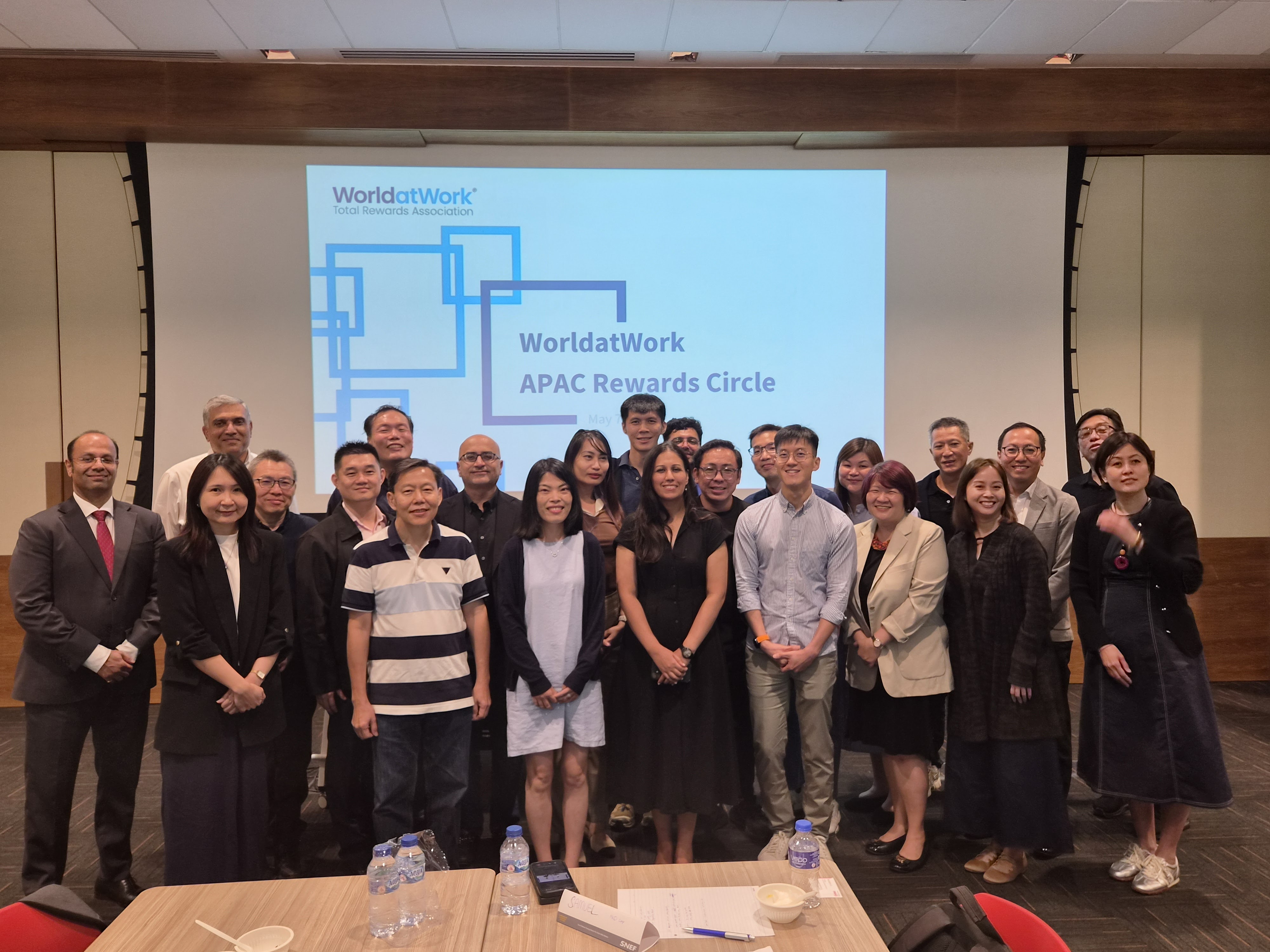
Group photo of attendees at WorldatWork’s recent Asia-Pacific (APAC) regional meeting in Singapore.
The event highlighted a growing consensus among APAC organizations: Rewards can no longer be evaluated only through cost efficiency or administrative simplicity. Instead, leaders are increasingly expected to demonstrate how rewards investments create measurable business value through productivity, retention, engagement and workforce capability.
The discussion reflected a broader industry movement toward positioning rewards as a strategic business driver rather than a transactional HR function.
Moving Beyond Cost-Centric ROI
Historically, ROI discussions around rewards have largely focused on tangible financial outcomes such as:
- Benefits utilization;
- Administrative efficiency;
- Program costs;
- Healthcare spend reduction; and,
- Compensation benchmarking.
Participants noted that many organizations still evaluate rewards investments primarily through expense management. In some cases, flexible benefits programs are replaced with simpler flat allowances because they reduce third-party administrative costs and operational complexity.
However, these rewards leaders emphasized this approach is becoming increasingly outdated in a workforce environment shaped by rapid skill evolution, changing employee expectations and productivity gains driven by artificial intelligence (AI).
The future state of ROI, according to attendees, is shifting toward broader organizational outcomes such as:
- Productivity improvement;
- Employee engagement;
- Retention and loyalty;
- Innovation capability;
- Workforce agility; and,
- Employee experience.
Several discussed examples illustrated this transformation. Participants highlighted how AI-enabled tools can significantly reduce manual work, such as generating reports in hours instead of days, thereby improving employee productivity and business responsiveness.
The discussion reinforced that organizations are increasingly asking not only “How much are we spending on rewards?” but, more importantly, “How effectively are our rewards investments creating business value?”
AI Emerging as a Strategic Rewards Enabler
AI, not surprisingly, was one of the most discussed themes during the meeting.
Rather than viewing AI primarily as a workforce replacement tool, participants largely agreed its immediate impact is likely to center on augmentation, which is helping employees work faster, make better decisions and access deeper workforce insights.
Leaders discussed how AI is expected to significantly influence the future of rewards strategy through:
- Predictive workforce analytics;
- Personalized employee experiences;
- Skills mapping;
- Dynamic career recommendations; and,
- Flexible rewards design.
One notable concept discussed was the emergence of “hyperpersonalized” rewards models, sometimes referred to informally during the session as “flex pay by generation.”
Participants noted workforce expectations are increasingly shaped by demographic differences and life stages, closely reflecting findings from WorldatWork’s recent State of Rewards Report.
For example:
- Generation Z employees often prioritize flexibility, lifestyle benefits and purpose-driven work.
- Mid-career employees may place greater emphasis on learning opportunities, career progression and financial well-being.
- Senior workforce segments may value healthcare, retirement security and stability.
AI-enabled rewards systems increasingly allow organizations to tailor their rewards offerings based on employee preferences, behaviors and workforce segments rather than relying on standardized, one-size-fits-all programs.
The conversation also raised strategic questions around investment priorities. Leaders debated whether organizations may eventually allocate greater budgets toward AI and productivity-enhancing tools instead of traditional compensation increases if the long-term ROI proves stronger.
Career Growth Becoming a Core Reward Element
Another major theme was the growing recognition of career growth itself as a critical rewards component.
Participants emphasized employees increasingly view internal mobility, learning opportunities, career transparency and skill development as key drivers of organizational value and engagement.
Concerns were raised around limited visibility into career pathways and the lack of talent mobility within many organizations. Participants noted future-ready organizations will need to create more transparent and skills-based career ecosystems to retain talent.
Manager accountability also emerged as a critical factor. Several attendees highlighted that rewards ROI improves when leaders are evaluated not only on business outcomes but also on how effectively they develop talent and enable career growth within their teams.
The discussion further emphasized the growing shift toward skills-based rewards models. Participants noted organizations are increasingly moving away from traditional indicators such as tenure, educational pedigree, age and hierarchical structures. Instead, they are moving toward rewarding employees based on demonstrated skills, capabilities and impact.
This approach was viewed as essential for:
- Improving workforce agility;
- Supporting pay equity;
- Reducing unconscious bias and ageism; and,
- Encouraging continuous learning.
Recognition and Culture Continue to Drive Value
Recognition also emerged as a significant discussion area, particularly its evolving role in strengthening organizational culture and employee engagement.
Participants noted traditional recognition programs often struggle because they are infrequent, manager-dependent or disconnected from business priorities.
Instead, organizations are increasingly exploring:
- Peer-nominated recognition platforms;
- Real-time recognition systems;
- Culture-driven recognition models; and,
- Social recognition tools.
The discussion emphasized recognition programs are most effective when they reinforce desired organizational behaviors and cultural values. One recurring idea during the session was the importance of “catching employees doing it right.”
Participants agreed that meaningful recognition can strengthen:
- Employee belonging;
- Engagement;
- Trust;
- Cultural alignment; and,
- Retention of high performers.
Recognition also was viewed as a critical “soft ROI” lever that indirectly contributes to productivity and business performance.
Well-Being, Employee Experience Remain Strategic Priorities
The conversation also reflected growing acknowledgment that employee well-being and experience are becoming increasingly difficult to separate from business outcomes.
While participants acknowledged that well-being ROI can be difficult to quantify directly, many agreed that investments in mental well-being, flexibility, work-life balance and employee support programs have measurable long-term effects on engagement, retention and productivity.
The session reinforced that organizations are moving toward broader ROI definitions that include both:
- Hard metrics such as cost reduction and productivity; and,
- Soft metrics such as trust, belonging, culture and employee sentiment.
The Future of Rewards
Discussion at the APAC meeting ultimately reflected a broader transformation occurring across the HR and rewards professions. As AI, workforce expectations and business priorities continue to evolve, organizations are increasingly expected to design rewards strategies that are:
- Personalized;
- Skills-focused;
- Data-driven;
- Experience-centric; and,
- Business-impact oriented.
The session underscored that the future of rewards will likely depend on balancing technology, human experience and measurable organizational outcomes.
For HR and rewards leaders, the challenge ahead is no longer simply managing rewards spend but demonstrating how rewards investments contribute to sustainable business performance and workforce resilience in an increasingly complex world of work.
Editor’s Note: Additional Content
For more information and resources related to this article, see the pages below, which offer quick access to all WorldatWork content on these topics:

#1 Total Rewards & Comp Newsletter
Subscribe to Workspan Weekly and always get the latest news on compensation and Total Rewards delivered directly to you. Never miss another update on the newest regulations, court decisions, state laws and trends in the field.