
For WorldatWork Members
- 5 Minutes With … Winnie Roberts, McKesson’s VP of Sales Comp, Workspan Magazine article
- 3 Sales Compensation Challenges that AI Can Help Tackle, Workspan Magazine article
- Sales Performance Management, research
- Sales Compensation Programs and Practices, research
- Manager Quota Allocation Tool, tool
- Sales Quota Setting Guide, tool
- Sales Performance Management Technology Selection Guide, tool
For Everyone
- The Evolving Role of Discretionary Rewards to Recognize Sales Results, Workspan Daily article
- From Control to Clarity: Methods to Modernize Sales Comp Governance, Workspan Daily article
- To Fix Sales Comp Performance, You First Need to Fix the Philosophy, Workspan Daily article
- Sales Compensation Design: What Are the Keys to an Effective Plan? Workspan Daily article
- Beyond Market Data: Building Effective Pay Structures for Sales Jobs, Workspan Daily article
- Sales Compensation Course Series, education


Where should an organization position pay for its sales representatives versus the market? The answer is more complicated than choosing the 50th, 75th or 90th percentile. The right position depends on what the company expects from sellers, how difficult those expectations are to achieve, and what it takes to attract and retain the talent capable of delivering them.
Most sales roles include two primary forms of cash compensation:
- Base salary, the fixed portion of pay; and,
- Incentive pay, the variable portion that may be described as a bonus or commission.
Together, these components make up total target cash (TTC) compensation, also commonly referred to as on-target earnings (OTE). TTC or OTE represents the total cash compensation a sales representative is expected to earn at target performance.
Pay Positioning Is More Than a Market Percentile
Organizations approach market positioning differently based on culture, business strategy and management philosophy. Many set target pay at the market median, or 50th percentile. Companies with a more aggressive pay-for-performance orientation may aim for the 75th or even 90th percentile. Others intentionally position below the market, relying on stability, culture, career opportunity or other elements of the employee value proposition to remain competitive.
The percentile itself, however, tells only part of the story. A company may target pay at the 75th percentile, but that positioning needs to be considered alongside the difficulty of achieving quota. A market-leading target opportunity can be much less compelling if only a small proportion of the sales force can realistically achieve it. The credibility of the pay opportunity, therefore, depends not only on the target amount but also the likelihood that capable performers can earn it.
The reverse also can be true. Consider a company with a stable, experienced sales force and historically low turnover. Stability, internal equity and the broader work environment may give the organization more flexibility in setting its market position. If target pay is positioned near the 40th percentile and quota is calibrated at an attainable level, many representatives may meet or exceed target. Actual earnings can then approach or surpass the market median, even though the stated target opportunity was positioned below it.
The practical lesson is straightforward: Pay positioning and performance positioning must be designed together. Market percentile, quota difficulty and realized earnings should tell a consistent story.
The Factors That Shape the Right Market Position
Preference alone shouldn’t drive the selection of a pay position. The following seven factors can give the design team a more disciplined way to evaluate the organization, the talent market and the demands of the role. Considered together, these factors help clarify whether lower, median or higher target pay is most appropriate.
1. Degree of Industry Stability
Higher uncertainty generally requires greater potential reward. How much risk is associated with the company and the market in which the company operates? Startups and less established ventures often need to offer greater potential rewards because prospective employees accept more uncertainty. The more risk a candidate is asked to take, the more reward that candidate may expect in return. Established companies with longevity, a proven business case and a strong track record may be able to position target pay lower because stability is itself a meaningful part of the rewards proposition.
2. Desired Business Results
More demanding outcomes strengthen the case for greater earnings opportunity. How likely is the organization to achieve its business goals? When goals are relatively attainable, median or below-median target pay may be sufficient. When the organization is pursuing difficult growth, revenue or profitability objectives, a stronger earnings opportunity may be required to reinforce the expected performance level and reward those results when they are achieved.
3. Expected Employee Performance at Target
The target opportunity should reflect the performance standard represented by quota. What level of individual performance does the organization expect at quota? Target pay should reflect the standard represented by target performance. A role designed around average, repeatable execution may support a market-median opportunity. A role that demands stretch performance, exceptional skill or unusually high impact generally requires a more competitive target opportunity.
4. Productivity Level
Stronger economics generally provide more capacity to support higher target pay. How productive and profitable is the organization? Productivity often is reflected in margins, profit or the sales role’s created economic value. Companies that sell high-margin products or services and generate greater profitability are typically better able to support higher target pay. In lower-margin environments, compensation costs may need to be managed more tightly.
5. Supply of Talent
Scarcer or more specialized skills put upward pressure on target pay. How readily available is the talent required for the job? When qualified candidates are abundant, an organization may not need to lead the market on pay. When talent is scarce, specialized or in high demand, a higher target opportunity may be necessary to attract and retain people with the required capabilities.
6. Mobility of Employees
A highly mobile talent market increases competitive pressure on compensation. How likely are sales representatives to move between employers? Some talent markets include highly mobile “hired guns” who frequently pursue the next compensation opportunity. Other workforces are more stable, loyal and inclined to build a long-term career with one employer. Greater mobility generally places more pressure on the organization to offer stronger market positioning, while a stable workforce may allow for a more moderate approach.
7. Staffing
Greater individual workload and influence can justify a higher target opportunity. What’s the typical workload, and how much influence does one sales representative have over the result? When many people perform similar work or sales are supported by a broader team, workload and accountability are distributed across multiple roles. That model may support lower individual target pay. In a lean organization, each representative may carry greater workload, responsibility and influence over the sale, strengthening the case for higher target compensation.
Bringing the Factors Together
No single factor should determine the answer for pay positioning. The framework’s value comes from evaluating the full set of conditions and identifying the direction in which the evidence points. Responses toward the left side of the figure below generally support lower-to-median target pay. Responses toward the right strengthen the case for higher target pay. The organization may also choose to weigh certain factors more heavily when those considerations are especially important to its business or talent strategy.
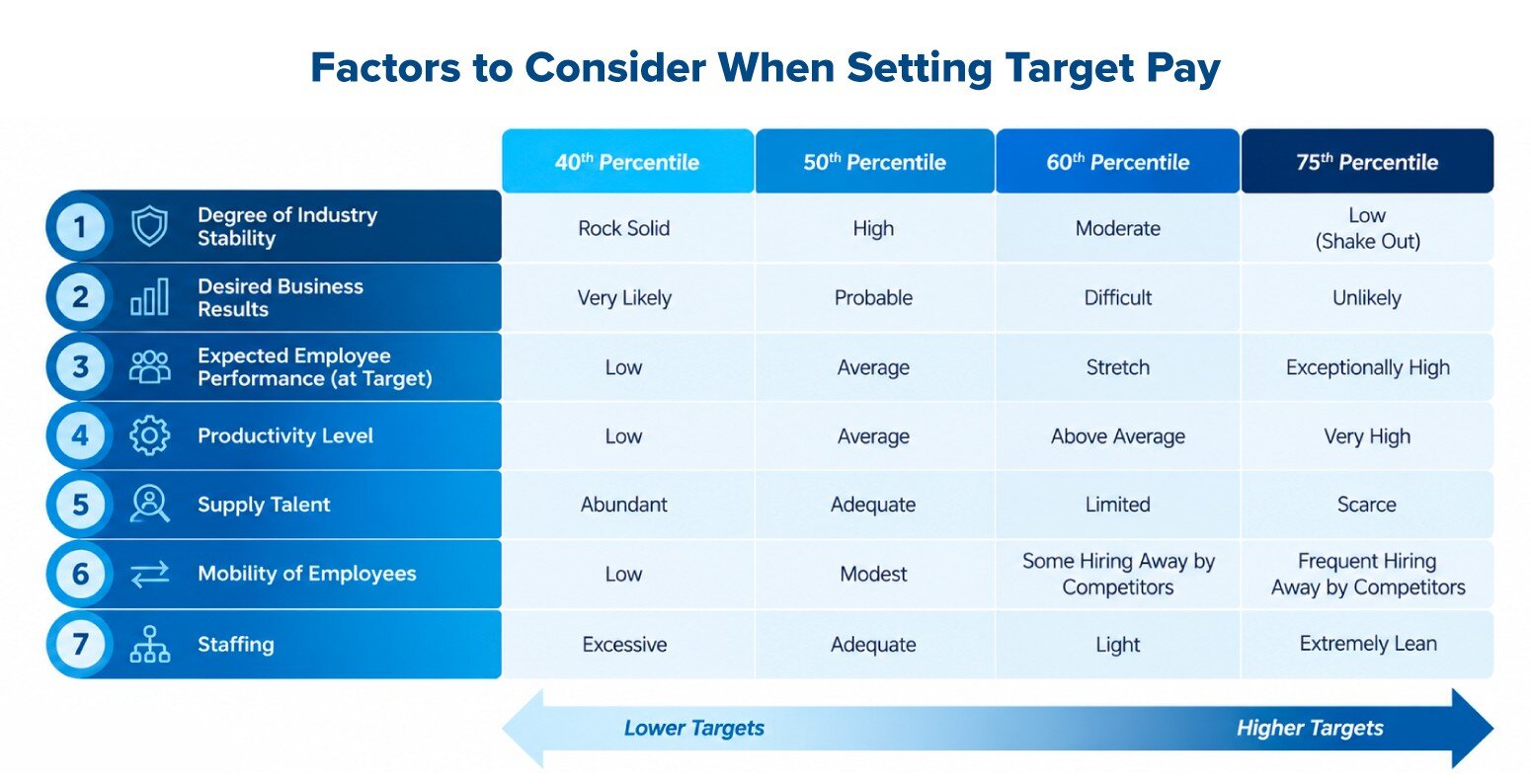
The framework is directional, not prescriptive. Organizations should consider the seven factors collectively rather than use any single response to determine a target market percentile. The relative importance of each factor will vary by sales role, business model, talent market and compensation strategy.
A Coherent Pay Story
Ultimately, market positioning isn’t about choosing the highest percentile a company can afford. It’s about choosing the position that makes sense for the business, role and talent market, and then ensuring pay opportunity and performance expectations reinforce one another.
When those elements are aligned, sales compensation becomes a clear expression of what the organization expects, values and is willing to reward.
Editor’s Note: Additional Content
For more information and resources related to this article, see the pages below, which offer quick access to all WorldatWork content on these topics: