For WorldatWork Members
- 5 Minutes with Becky Cantieri, Chief People Officer for SurveyMonkey, Impact Magazine article
- 5 Minutes with Jayney Howson, Chief Learning Officer for ServiceNow, Workspan Magazine article
- 5 Minutes With … Sven Skillrud, NIKE Inc.’s TR and People Solutions VP, Workspan Magazine article
- 5 Minutes With … Chris Guzman, Darden Restaurants’ VP of Compensation, Workspan Magazine article
- 5 Minutes With … Martha Cook, Global TR, HR Innovation Adviser, Workspan Magazine article
- 5 Minutes With … Courtney Brown, Dell Technologies’ SVP, Total Rewards, Workspan Magazine article
For Everyone
- Cutback Considerations: Are You Removing Roles or Removing Work? Workspan Daily article
- BIG Ideas: Learn How to Get the Most Out of a Small HR Budget and Team, Workspan Daily article
- Recognize that Employee Recognition Needs Some Attention, Workspan Daily article
- Hard Choices, Soft Solutions: A Considerate Approach to Compensation, Workspan Daily article
- Making the Leap to a Pay-for-Performance Approach That Works, Workspan Daily article
- Are You Speaking Gen Z’s Language When It Comes to Total Rewards? Workspan Daily article
- WorldatWork’s TR27, conference


At WorldatWork, “being global” means embracing a worldwide perspective in how the association furthers professional development through editorial, education, credential, community and research offerings. It reflects our commitment to serving HR, Rewards and people leaders across diverse countries, cultures, industries and business environments.
Being global means recognizing that while workforce challenges may be shared across borders, their solutions are often shaped by local market conditions, cultural norms, economic realities and regulatory requirements. We strive to balance universally applicable principles with regional relevance, ensuring our resources, insights and experiences reflect the diversity of today’s workforce.
Global is defined by our ability to bring together diverse perspectives, foster cross-border learning and prepare professionals to succeed in an increasingly interconnected world of work.
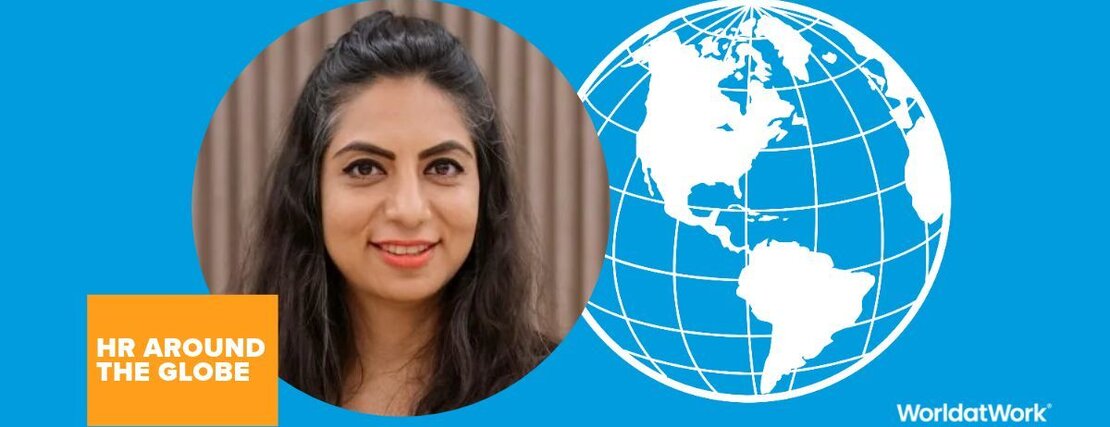
To that end, WorldatWork Today (WT) unveils “HR Around the Globe,” an editorial feature where we will highlight HR and Rewards professionals in different parts of the world to gain insights on their career paths, challenges, opportunities and successes.
For our first installment, we interviewed Medhavini Kathuria, the director of Asia-Pacific total rewards business partnering at Lonza. Lonza is a Switzerland-headquartered multinational manufacturing and life sciences company. Kathuria is a in Hyderabad, India-based practitioner who also has held HR/Rewards roles at UKG, FIS, FedEx, Aricent, Aircel and Delta Electronics.
WT: Why do you enjoy working in HR? What about the profession brings you joy and/or satisfaction?
Kathuria: What fascinates me most about HR is that we work with perhaps the most complex and unpredictable part of any business: people. There is rarely one perspective, one expectation or one perfect answer. That makes the profession challenging, with constant opportunities to learn and appreciate different viewpoints.
What gives me immense professional satisfaction is bringing structure to chaos and simplifying complexity. The true test is when leaders can confidently explain decisions and employees understand the rationale without HR having to step in. That’s when we’ve achieved clarity, trust and shared ownership.
On a personal level, the joy comes from the smallest moments: when an employee receives support when they need it most or a colleague appreciates that HR stood firm for a fair outcome. Those moments remind me that we’ve protected what matters and made a genuine difference. And when I see that fairness reflected in how people experience the organization every day, it’s rewarding to see that the intent behind the design has become part of the culture.
WT: How did you get your start in HR?
Kathuria: I started with mathematics, accountancy and commerce, then chose psychology, followed by HR over marketing for my postgraduate studies. I was drawn to both analytical thinking and human behavior without quite realizing how closely the two were connected in business.
Early in my career, I often heard HR described as a support function. I’ll admit, I questioned how much influence it could really have. Working across manufacturing, telecommunications, financial technology, IT services, logistics, SaaS [software as a service] and now life sciences changed that perspective. I saw how leadership decisions, talent development and organizational culture could drive a business forward or hold it back.
Each industry has different needs, but one lesson has stayed with me: People shape the success of a business, and HR plays a critical role in enabling that success. What I once questioned as a support function, I now see as fundamental to business strategy.
WT: What is trending and top of mind these days for HR professionals in India?
Kathuria: First, India is growing in prominence as a global capability center (GCC) destination. With more than 2,100 GCCs, India is attracting increasingly specialized and complex work across technology, engineering and global functions. This raises the bar for HR in building specialized talent pipelines, leadership capabilities and alignment with global operating models.
Second, India faces a talent paradox. Despite a vast talent pool, finding, developing and retaining the right skills remains a challenge. With artificial intelligence (AI) transforming jobs, we can’t keep paying a premium for new skills while overlooking opportunities to develop our existing workforce. Reskilling, internal mobility and effective change management must go hand in hand.
Third, India’s Labor Codes are being implemented. Their implications extend beyond compensation to industrial relations, social security, workplace safety and working conditions. For HR, this is an opportunity to reassess existing practices, strengthen employee protections and align regulatory requirements with business realities.
India’s opportunity is growing. The real test for HR is whether we’re building the workforce, leadership and people practices to match it.
WT: What are some of the biggest functional challenges and/or opportunities HR professionals like you are facing in India?
Kathuria: India’s rise as a GCC hub makes a “glocal” approach essential: globally consistent principles with locally relevant practices. India’s median workforce age is 29 — versus 39 in the U.S., 38 in Australia and 45 in the European Union. Unemployment also varies significantly across countries; in India, it exceeds 25% among young urban women, even as employers struggle to find specialized skills. These differences shape organizational structures, career progression, learning, diversity strategies and benefits. Even within India, realities differ across states and cities. A common organizational philosophy matters, but identical practices can’t work everywhere.
The challenge is bringing global and local leadership to a common understanding. For me, it starts with organizational culture, business strategy and affordability, alongside local market realities and employee needs. Different experiences shape expectations. It takes listening and education to understand different perspectives, and the conviction to put facts and data on the table, speak candidly and bring leaders along.
And, that’s HR’s biggest opportunity: turning that alignment into genuinely glocal decisions, grounded in one shared source of truth, that strengthen organizational culture, create meaningful long-term careers for India’s growing workforce and support sustainable business growth.
WT: What are one or two of your biggest HR triumphs, and what did it take to accomplish them?
Kathuria: One of my biggest transformation achievements was redefining our employee value proposition (EVP) as we scaled in India against established brands. Workforce insights, attrition patterns, market intelligence and employees’ evolving life stages informed differentiated family-building and healthcare benefits. Aligning global HR, business leadership and finance across different market realities took data, candid conversations and collaboration. One strategy achieved multiple objectives: setting a new market benchmark, strengthening employer branding and supporting long-term retention, while maintaining financial discipline.
Equally significant was embedding transparency, fairness and equity into organizational culture. We equipped leaders to confidently explain job architecture, pay decisions and equitable practices through real employee scenarios. This strengthened leadership ownership and contributed to significant improvements in [Great Place to Work] scores on pay fairness and benefits. Awareness and utilization increased, with a benefits provider approaching us to understand our exceptional adoption rates. Transparency became more than a policy; it became something employees could experience.
I’ve received considerable recognition over the years, but what stays with me is how these efforts made a difference to people: when an employee says the organization genuinely cared, or someone acknowledges that a difficult decision was handled fairly, even when the outcome wasn’t in their favor. For me, that’s the recognition that matters most.
Editor’s Note: Additional Content
For more information and resources related to this article, see the pages below, which offer quick access to all WorldatWork content on these topics: