For WorldatWork Members
- Incentive Pay Practices, research
- 2025-2026 Salary Budget Survey, research
- How to Reward Top Performers When Pay Raises Aren’t Possible, Workspan Daily Plus+ article
- Emphasize the Value of Total Rewards During Economic Uncertainty, Workspan Daily Plus+ article
- How to Identify the Linkages Between Performance and Pay, Workspan Daily Plus+ article
- Volatility-Proofing Your Incentive Rewards Strategies, Workspan Magazine article
- Incentives and Recognition: An Evidence Review, Journal of Total Rewards article
For Everyone
- Total Rewards ’26, conference
- Prioritizing Performance: How Might This Push Impact Pay Strategies? Workspan Daily article
- The Pros and Cons of Giving Managers Discretion on Merit Increases, Workspan Daily article
- Alignment, Market Competitiveness Are TR Leaders’ Top 2026 Priorities, Workspan Daily article
- Business Acumen and Communication Strategies in Total Rewards, course
- Base Pay Administration and Pay for Performance, course


Compensation professionals are pulled in divergent directions. Do you choose:
- Structure or strategy?
- Governance or flexibility?
- Policy or partnership?
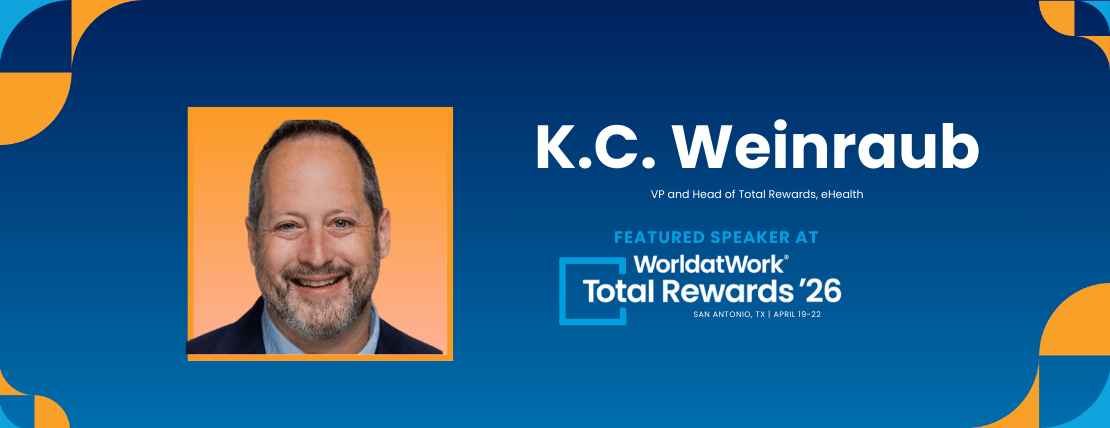
K.C. Weinraub, a vice president and the head of total rewards at private health insurance exchange company eHealth, believes an and (instead of an or) proposition is possible, but it takes a bit of doing.
This HR pro and four industry colleagues will share deep insights, tips and frameworks on the subject during a panel discussion at WorldatWork’s Total Rewards ’26 conference, which runs April 19-22 in San Antonio, Texas.
Besides Weinraub, the April 21 session, titled “Structure Meets Strategy: The Soft Skills Behind Compensation Success,” will feature:
- John Waldron, the group manager overseeing executive compensation and compensation strategy at automaker Toyota North America;
- Bryan Briscoe, the VP of total rewards and HR operations Americas at industrial machinery manufacturer TK Elevator;
- Nancy Romanyshyn, the senior director of total rewards strategy and solutions at HR technology company Syndio; and,
- Justin Hampton, the founder and CEO at HR tech company CompTool.
Workspan Daily editor Paul Arnold recently interviewed Weinraub on ways compensation pros can lean into hard skills and soft skills to achieve business balance and better outcomes.
Check out Workspan Daily’s on-site coverage of Total Rewards ’26:
- There Is a Distinct Power in Knowing What Matters to Your Workers
- WorldatWork, HRCI Leaders Kick Off Program Exploring Work’s New Era
- Why Bravery Is a Formal Habit HR Pros Need to Build and Lean Into
- Cha-Ching: How to Transform HR into a Profit Center
Check out Workspan Daily pre-conference coverage on Total Rewards ’26:
- To Enhance Employee Experience, Lean into Integrity, ‘Radical Honesty’
- Conference Session Takes Community Approach to Solving HR Problems
- BIG Ideas: Learn How to Get the Most Out of a Small HR Budget and Team
- Recognize that Employee Recognition Needs Some Attention
- Making the Leap to a Pay-for-Performance Approach That Works
- Are You Speaking Gen Z’s Language When It Comes to Total Rewards?
Arnold: Compensation can be analogous to a game of tug-of-war, with comp professionals caught in the middle and being pulled on one side to enforce structure and pulled on the other side to support strategy. What’s your take on this predicament? And, what are the inherent dangers in leaning too far one way or another?
Weinraub: That’s the job. When operating in a functional and consultative capacity, the compensation role is one of discernment and balance. There are inherent risks in leaning too far in either direction. The goal is to consult, enable and evaluate decisions — and then rinse and repeat, learning and fine-tuning what is right for organizational performance and culture.
Arnold: In what ways are hard skills and business acumen sufficient to address comp policies and practices, and in what ways might they fall short?
Weinraub: Hard or technical skills and business acumen will certainly advance your career, up to a point. Beyond that, emotional quotient [also known as emotional intelligence] and communication skills must be sharpened to effectively steer policies and practices across organizational leadership and culture. The ability to galvanize others is a critical soft skill that supports shared understanding and sound decision-making.
Arnold: How might soft skills, in particular empathy and communication, be a game-changer here?
Weinraub: Soft skills are the new game-changer. They create the bridge between sound policy design and true adoption. Empathy allows leaders to anticipate how decisions will be received and experienced, not just how they look on paper. Communication ensures that intent, tradeoffs and context are clearly understood. Together, they build trust. And, trust is what ultimately sustains the organization’s culture.
Arnold: How have you seen this put into practice in your role at eHealth or with other companies during your professional journey? Could you share an example or two of how you’ve applied soft skills to achieve balance and compensation success?
Weinraub: At eHealth, our HR leadership team is actively developing around our three Cs: consulting, coaching and change management. Those capabilities directly influence how we approach compensation. Instead of simply delivering decisions, we focus on listening deeply, framing tradeoffs transparently and guiding leaders through implications.
Arnold: What leading practices or lessons learned may prove helpful for those looking to re-examine what they are doing in this area?
Weinraub: A key lesson I’ve learned is that compensation success depends as much on how decisions are communicated as on the decisions themselves. Strong governance and clear criteria create confidence in the “what,” but transparent communication builds trust in the “why.”
Check out Workspan Daily’s coverage of the Total Rewards ’25 conference:
- Might a Sales Mindset Be Your Key to Total Rewards Success?
- The Monumental Mission of Meaningful Mentorships
- Proactive TR Pros See ‘Train’ of Change Coming, Take Steps to Act
- The Keys to Creativity and Driving Innovative Total Rewards
- The Pros and Cons of Giving Managers Discretion on Merit Increases
- Using Analytics, Innovative Framework to Transform HR/Total Rewards
- How An Industry Leader Sees Technology Transforming Total Rewards
- Biopharma Compensation Leader Has Put AI Under the Microscope
Editor’s Note: Additional Content
For more information and resources related to this article, see the pages below, which offer quick access to all WorldatWork content on these topics:

#1 Total Rewards & Comp Newsletter
Subscribe to Workspan Weekly and always get the latest news on compensation and Total Rewards delivered directly to you. Never miss another update on the newest regulations, court decisions, state laws and trends in the field.