For WorldatWork Members
- Eye-Opener: Don’t Hit the Snooze Button on Culture, Workspan Magazine article
- Roused and Recharged: How to Boost the Power of a Culture Audit, Workspan Magazine article
- How Workplace Culture Can Improve Engagement and Retention, Workspan Daily Plus+ article
- The Digital Watercooler: Building the Culture Connection Remotely, Workspan Daily Plus+ article
- The Ethics of Influence: A Nudge Technology Question List, Workspan Daily Plus+ article
For Everyone
- Could Culture Be the Most Important Benefit You Provide Your Workers? Workspan Daily article
- How to Sustain a Strong Workplace Culture During Rapid Growth, Workspan Daily article
- Nudgetech! What It Is, and How It Can Aid the Total Rewards Function, Workspan Daily article
- Culture May Be the Antidote to Your Toxic Work Environment, Workspan Daily article


“If someone doesn’t feel seen, connected, supported and proud of their work, they aren’t going to take the risks that drive innovation. You can’t willpower your way to psychological safety. The experience has to earn it.”
— Brad Shuck, entrepreneur and university professor/researcher
In an era defined by rapid transformation and the most fluid workforce in history, the traditional work rules have vanished. While organizations often rely on high-level cultural narratives, a leading voice in organizational behavior warns they are missing the “silent signals” that truly define the employee experience.
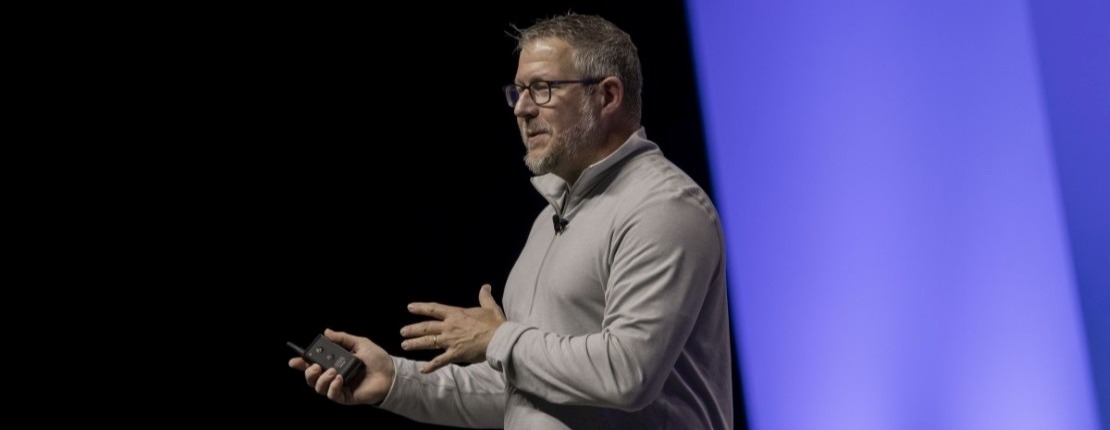
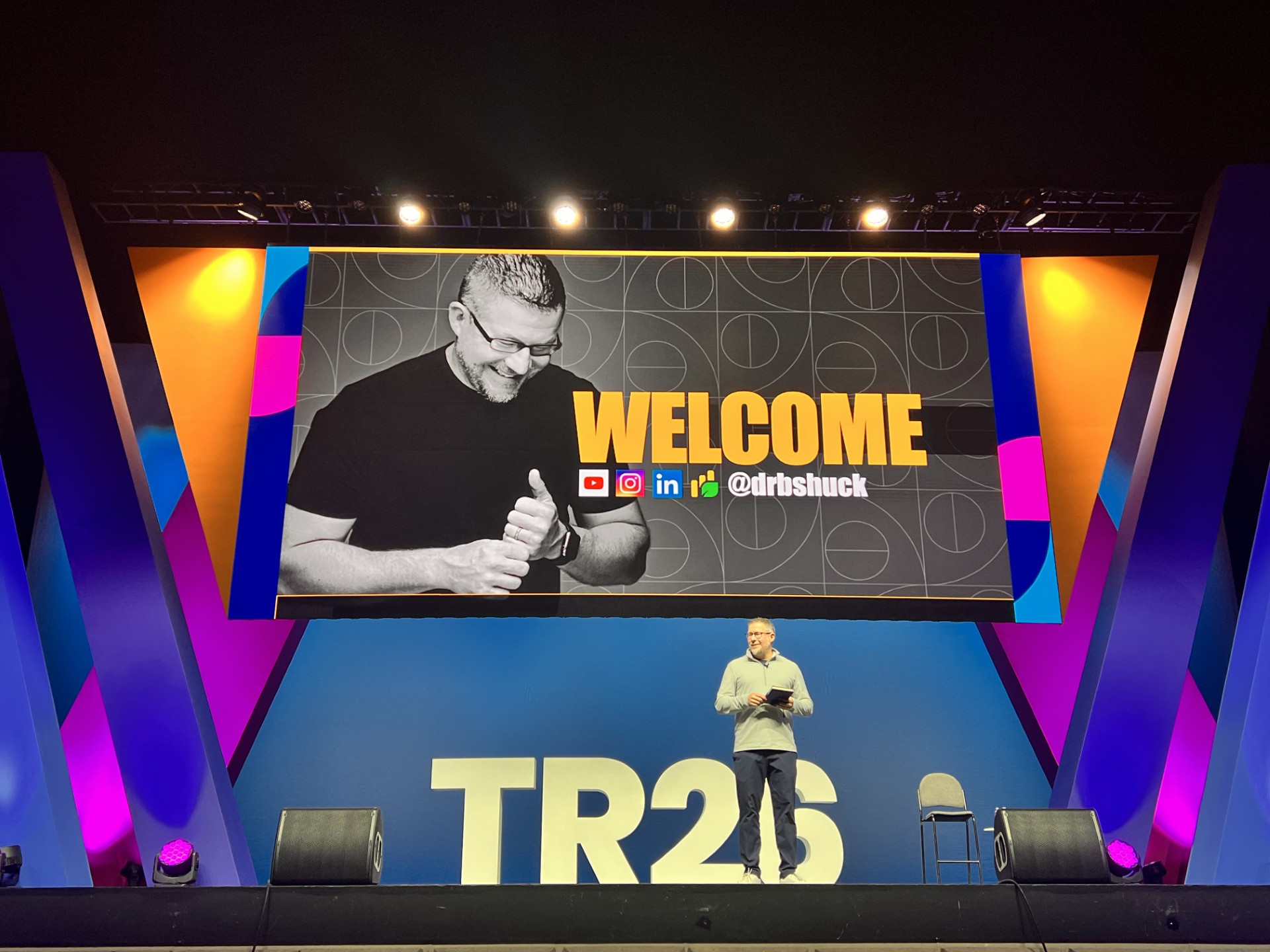
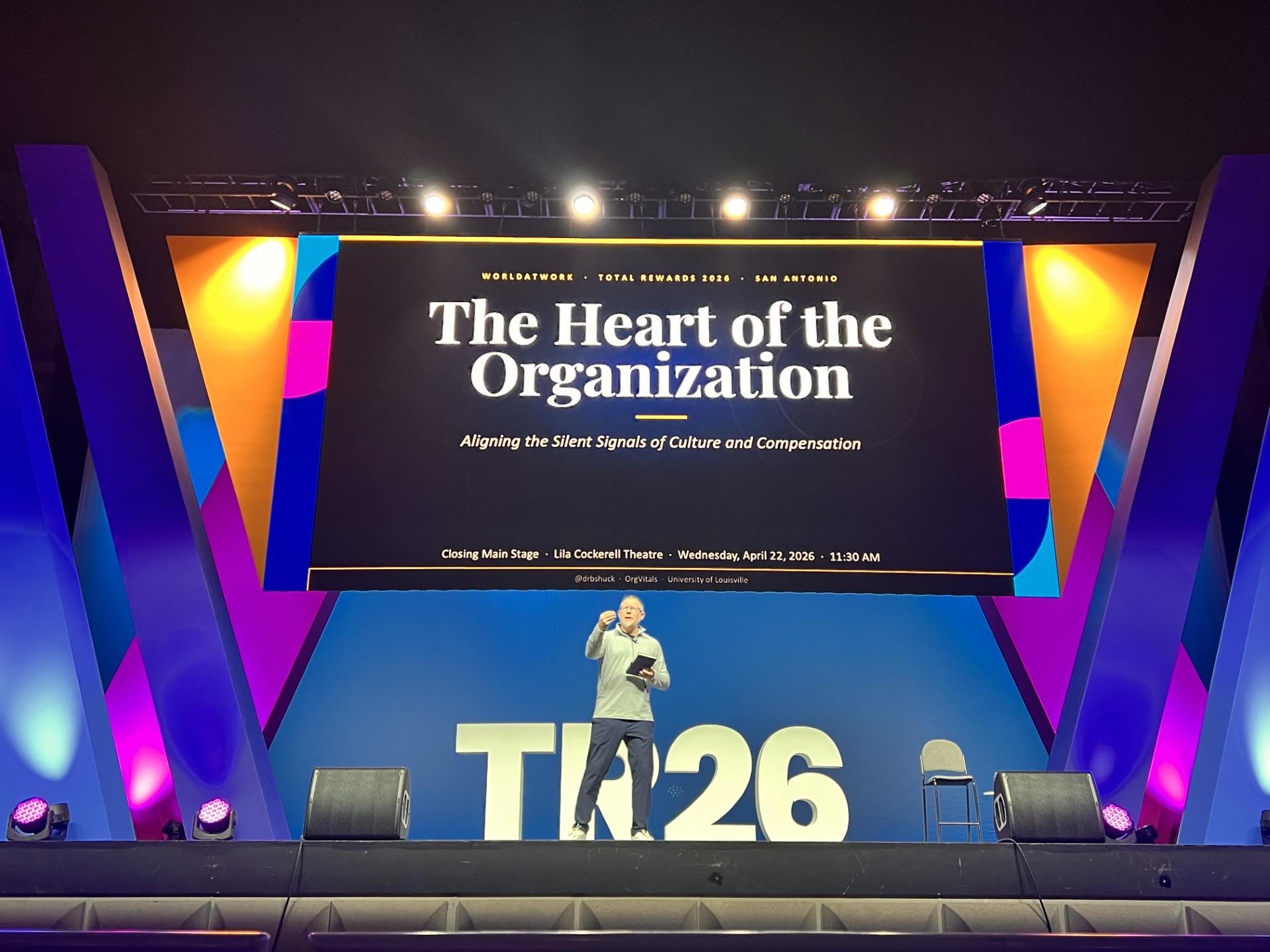
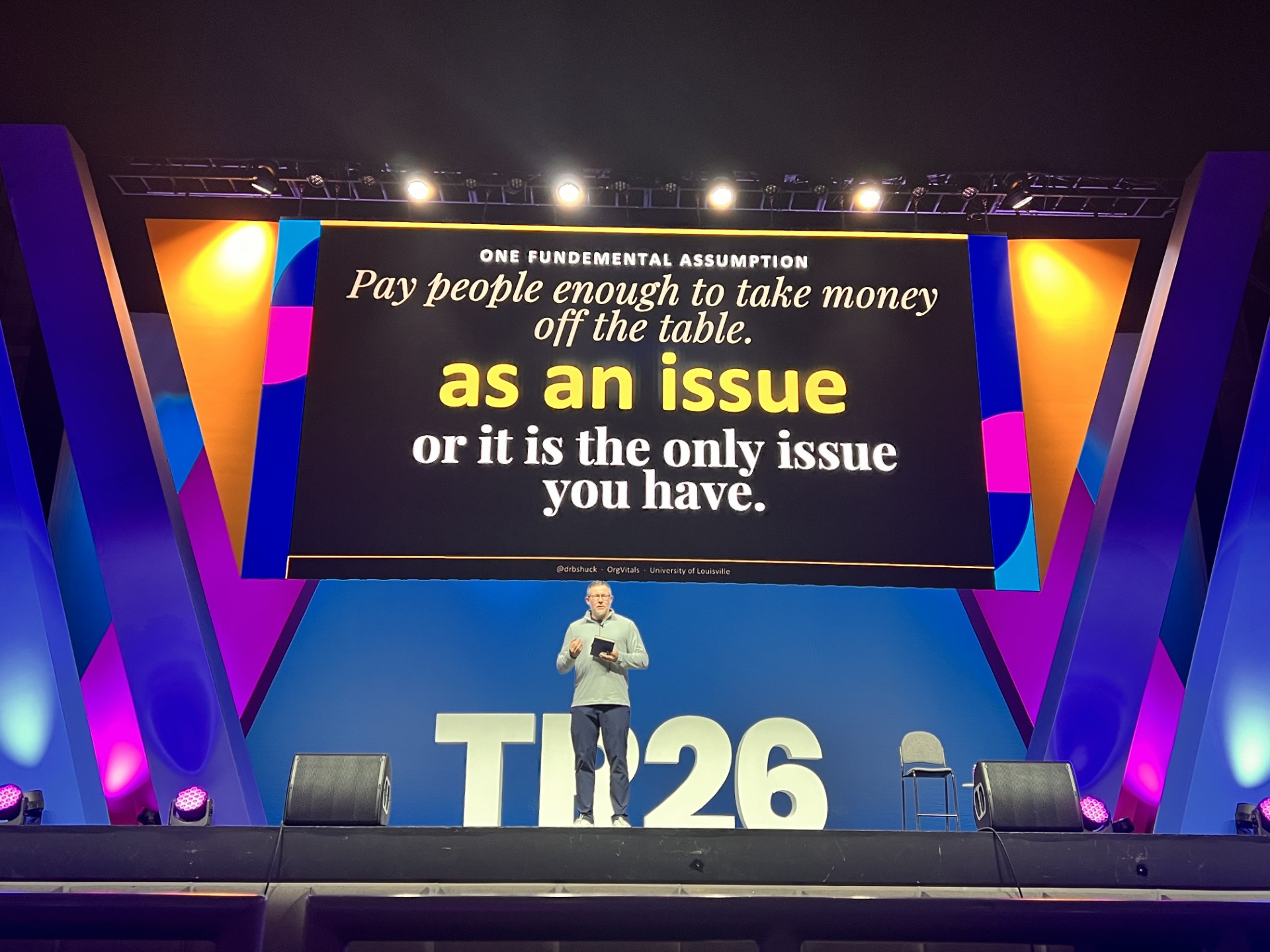
In a main stage address on Wednesday, April 23, at WorldatWork’s Total Rewards ’26 conference in San Antonio, Texas, scholar/entrepreneur Brad Shuck challenged the audience of more than 2,000 HR and total rewards (TR) professionals to stop simply “checking a box” and instead move toward principle-driven values that foster genuine psychological safety, meaning and long-term value.
Shuck is a professor and researcher at the University of Louisville, the co-founder of culture-analytics software platform OrgVitals and the founder of LEAD Research.
His message, driven home in his session titled “The Heart of the Organization: Aligning the Silent Signals of Culture and Compensation,” is that culture isn’t just what an organization says in its mission statement; it’s what employees experience every day through systems, decisions and tradeoffs. These signals, though often overlooked, heavily dictate whether an organization can attract and retain top talent.
Workspan Daily (WD) interviewed Shuck for a conversation on culture, compensation, employee experience and the future of work.
Check out Workspan Daily’s on-site coverage of Total Rewards ’26:
- There Is a Distinct Power in Knowing What Matters to Your Workers
- WorldatWork, HRCI Leaders Kick Off Program Exploring Work’s New Era
- Why Bravery Is a Formal Habit HR Pros Need to Build and Lean Into
- Your Voice and Vision May Be Your Most Important HR Leadership Tools
- Cha-Ching: How to Transform HR into a Profit Center
- What’s Your Role in Making AI a Responsible HR/TR Tool?
Check out Workspan Daily’s pre-conference coverage of Total Rewards ’26:
- To Enhance Employee Experience, Lean into Integrity, ‘Radical Honesty’
- Conference Session Takes Community Approach to Solving HR Problems
- BIG Ideas: Learn How to Get the Most Out of a Small HR Budget and Team
- Recognize that Employee Recognition Needs Some Attention
- Hard Choices, Soft Solutions: A Considerate Approach to Compensation
- Making the Leap to a Pay-for-Performance Approach that Works
- Are You Speaking Gen Z’s Language When It Comes to Total Rewards?
WD: You often mention that organizations overlook the “silent signals” of culture. What are the most common silent signals that leaders unknowingly send, and how do they impact employee experience, as noted in your research on employee engagement?
Shuck: The loudest thing a leader does is what they do when no one is watching — except people are always watching. The silent signals aren’t the mission statement on the wall. They’re who gets promoted and who gets passed over. They’re whether you actually respond to the 5 p.m. email or wait until morning. They’re how a manager talks about a team member who just left the room.
My research consistently shows employees are extraordinarily sensitive to these signals — not because they’re cynical, but because their psychological safety and sense of belonging literally depend on reading them correctly. When those signals are inconsistent or contradictory, engagement collapses. The data on this is clear: Purpose and belonging are the two most powerful drivers of a thriving culture, and both are shaped far more by daily behavior than by formal policy.
The most damaging silent signal I see? A leader who says, “People are our greatest asset,” and then cuts their development budget without a single conversation about it. People don’t leave the mission — they leave the gap between what was promised and what was delivered.
WD: You advocate for moving from “practice-based strategies to principle-driven values.” What does this shift look like in everyday decision-making, rather than just in corporate mission statements?
Shuck: Practice-based strategies are the checklists. Principle-driven values are the why behind the checklist. Here’s the difference in real time: A practice-based leader asks, “Did we do the engagement survey?” A principle-driven leader asks, “Did anything actually change because of what people told us?” One is a box; the other is a commitment.
In everyday decision-making, this shift shows up in the room when a hard call must be made. Do you take the shortcut or do you stay anchored to the principle, even when it costs something? I’ve worked with leaders in Fortune 50 companies who are genuinely extraordinary at this. What separates them isn’t their practices — it’s that their principles are load-bearing, not decorative. When principles guide decision-making, people can predict how their leaders will behave under pressure. That predictability is what builds trust. And trust — supported by decades of engagement research, including my own — is the foundation on which sustained engagement is built.
WD: In your view, how does the employee experience act as a primary driver of psychological safety and meaningful work in today’s workforce?
Shuck: Here’s the thing about psychological safety that most people miss — it’s not a program you implement; it’s a condition that either exists or doesn’t based on what people experience every single day. And since the [COVID-19] pandemic, the bar for what constitutes a meaningful work experience has fundamentally shifted. People got a glimpse of a different life. They re-examined what work was costing them — not just financially, but physically and psychologically.
Our Work Determinants of Health research — which was the first study to connect workplace culture directly to biological biomarkers — showed the social and emotional environment of work shows up in your body [in the form of] stress hormones, chronic disease risk cardiovascular markers.
The employee experience isn’t a soft concept anymore. It’s a public health issue. So, when I say experience drives psychological safety, what I mean is this: If someone doesn’t feel seen, connected, supported and proud of their work, they aren’t going to take the risks that drive innovation. You can’t willpower your way to psychological safety. The experience has to earn it — and that earning happens in the everyday moments of work life, not in the annual engagement survey.
WD: What is the relationship between employee engagement and psychological safety, and how can leaders foster both simultaneously?
Shuck: Think of engagement as the engine and psychological safety as the road it drives on. You can have a powerful engine — people who are cognitively, emotionally and behaviorally invested in their work — but if the road is full of potholes, that engine gets destroyed. Psychological safety is the condition under which engagement can actually be expressed.
What my research has consistently demonstrated is people need to feel three things before they will bring their best selves to work. They need to feel that:
- Their contributions matter;
- Their manager has their back; and,
- Who they are is genuinely welcome here.
These aren’t soft feelings — they’re measurable psychological conditions that predict performance, retention and health outcomes. Leaders can begin to foster this simultaneously through one deceptively simple habit: noticing and naming good work, specifically and genuinely, and not in a performative way. “I saw what you did in that meeting. That took courage.” That isn’t a program. That’s a moment that changes team chemistry. Research continues to confirm direct manager behavior is one of the strongest predictors of both engagement and psychological safety — and that gives every leader an extraordinary, immediate leverage point.
WD: You argue compensation is one of the strongest cultural signals in an organization. How can HR leaders align pay fairness and compensation structures with their desired cultural values to attract elite talent?
Shuck: Compensation isn’t just a transaction — it’s a declaration of what you value. When there’s a gap between what a company says it values and what the pay structure actually reflects, people notice immediately — elite talent especially.
What I’ve observed across hundreds of organizations is the fastest way to destroy a culture of belonging or innovation is to have a compensation structure that tells a different story. If you say you value collaboration but every incentive rewards individual performance, you’ve sent a silent signal that collaboration is a nice-to-have. The most effective HR leaders I work with treat compensation design as a culture design problem first. They ask, “What behaviors do we need to see more of, and does our pay structure actually reward those behaviors?” That’s the alignment question. And for attracting elite talent in today’s market, transparency is non-negotiable. Elite performers aren’t afraid of your numbers. They are afraid of your ambiguity. Pay equity and pay transparency aren’t just legal considerations — they are engagement and retention strategies grounded in the principle that fairness is foundational to belonging.
WD: Can you share a story from your research or experience where a company successfully used everyday decisions — not big initiatives — to transform their culture?
Shuck: I worked with a healthcare organization that had a serious trust problem — not a policy problem, a trust problem. They had tried the retreats, the consultants, the new values poster in the break room. Nothing moved. What finally moved the needle was when their CHRO started doing something radically small: Every Friday, she sent a personal, specific email to three people — different people each week — acknowledging something concrete they had done that reflected the organization’s values. Not a blast email. Three people. That’s it.
Within six months, managers started doing the same thing for their teams. It cascaded organically. By the time we measured engagement a year later, they had moved multiple meaningful points on dimensions related to belonging and recognition. No formal initiative. No budget line. Just one leader deciding to move differently, consistently, at a human scale. That’s the story I return to again and again — culture isn’t built in the boardroom. It’s built in the small moments nobody thought were being counted. My research calls these “cumulative effects” — individual moments that seem negligible in isolation but compound into the actual lived culture of an organization over time.
WD: You’ve defined the future of work as one where intention is reflected in daily actions. For a leader wanting to learn more, what’s the single most important change they can make tomorrow to build a more positive and inspiring place of work?
Shuck: Ask better questions — and then actually wait for the answers. That’s it. Most leaders ask questions as a courtesy, not as a genuine inquiry. Tomorrow, before your first team interaction, try this: Ask one person, “What’s making your work harder than it needs to be right now?” And then, don’t fill the silence. Wait. The answers that come back are the blueprint. They will tell you more about your culture’s actual architecture than any engagement survey ever will.
The single most important shift in the future of work isn’t the technology or the flexible schedule — it’s leaders who demonstrate through their daily behavior that the people doing the work are worth genuinely listening to. My research on engagement antecedents shows manager behavior is the most proximal and powerful lever for shaping the employee experience. Curiosity is a leadership strategy. And unlike most strategies, it costs absolutely nothing to deploy — starting tomorrow.
WD: How can an integrated culture act as a stabilizing force against the high turnover and uncertainty we see in the current workforce and labor market?
Shuck: Turnover is expensive, but the most dangerous form of it is invisible — it’s the people who are still physically there but have already checked out on the inside. What my research shows is that an integrated culture — one where purpose and belonging aren’t aspirational talking points but lived, daily experiences — creates what I think of as psychological anchors. These are the reasons people choose to stay when the labor market is noisy and the next opportunity is always just one LinkedIn message away.
Organizations with integrated cultures don’t necessarily retain people because they pay the most. They retain people because employees feel they belong to something real — something worth staying for. The instability we’re seeing in today’s workforce is clarifying. It’s sorting organizations that were relying on inertia from organizations that have genuinely built something people want to be part of. Culture is the only competitive advantage that can’t be copied because it lives in the relationships, rituals and repeated daily choices that are entirely unique to each organization. That’s what makes it so powerful — and so worth investing in deliberately.
WD: You challenge leaders to “move differently.” What does “moving differently” mean in the context of employee experience and well-being?
Shuck: Moving differently means leading from a different place — not from efficiency or compliance but from genuine curiosity about the human beings you’re responsible for. It means slowing down long enough to notice what’s happening in your team, rather than what you are hoping is happening.
In the context of well-being, it means understanding — and this is where our Work Determinants of Health research gets real — that the conditions of work aren’t separate from your people’s health. The stress your team carries home isn’t disconnected from the culture you’re building on Monday morning. Moving differently means accepting that, as a leader, you’re a health variable. The way you run a meeting, the way you give feedback, the way you handle a bad quarter — these things are shaping your team’s physical and psychological health in ways we can now measure biologically. That isn’t a burden. That’s an extraordinary opportunity. Leaders who grasp this move differently — not as a performance but as a genuine expression of who they are choosing to be as a leader.
WD: How can organizations move beyond “checking the box” to ensure employees feel they can genuinely believe in the mission?
Shuck: Box-checking is what happens when organizations mistake activity for impact. You can survey your employees every quarter and never once act on what they tell you. You can run a well-being program while a manager two floors up is quietly burning people out. The research is unambiguous on this: The gap between what organizations say and what they do is among the single strongest drivers of disengagement. Employees aren’t cynical by nature — they become cynical by experience.
To move beyond the box, organizations need to close the loop publicly and consistently. When employees give feedback, show them what changed because of it. When you make a decision that affects people, explain the principle behind it — not just the outcome. And when you get it wrong, because you will, own it fast and correct it faster. Mission believability isn’t a communications problem — it’s a consistency problem. People believe what they see repeated over time — in the decisions made under pressure, in who gets recognized, in what gets tolerated — not what they read in an onboarding PDF. That’s what culture actually is.
Check out Workspan Daily’s coverage of the Total Rewards ’25 conference:
- Might a Sales Mindset Be Your Key to Total Rewards Success?
- The Monumental Mission of Meaningful Mentorships
- Proactive TR Pros See ‘Train’ of Change Coming, Take Steps to Act
- The Keys to Creativity and Driving Innovative Total Rewards
- The Pros and Cons of Giving Managers Discretion on Merit Increases
- Using Analytics, Innovative Framework to Transform HR/Total Rewards
- How An Industry Leader Sees Technology Transforming Total Rewards
- Biopharma Compensation Leader Has Put AI Under the Microscope
Editor’s Note: Additional Content
For more information and resources related to this article, see the pages below, which offer quick access to all WorldatWork content on these topics:

#1 Total Rewards & Comp Newsletter
Subscribe to Workspan Weekly and always get the latest news on compensation and Total Rewards delivered directly to you. Never miss another update on the newest regulations, court decisions, state laws and trends in the field.